
Usa Late Night Closer Jobs 2026: A Realistic Guide for Applicants Around the World
For anyone living outside the United States, the first thing to understand about these jobs is a slightly awkward one. American late-night closer jobs are easy to find and hard to take legally. Job boards list hundreds of them every week. Very few of those employers can hire someone who doesn’t already have the right to work in the US.
That doesn’t make the goal unrealistic. It means you have to go about it differently from a local applicant. This guide explains what the job involves, what it pays, which legal routes exist for international workers, and where things tend to go wrong.
What a Late-Night Closer Actually Does
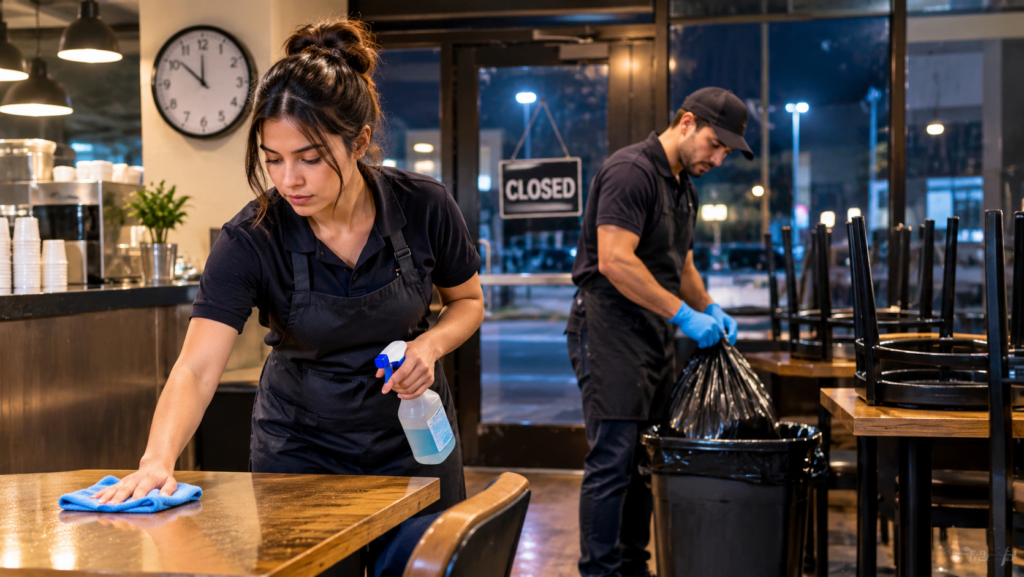
A closer is whoever is still working when a business ends its day. The customers may leave at 10 p.m., but the closer’s shift keeps going, and because the building has to be ready for the next morning.
The details depend on the where you work. In a restaurant, closing usually means breaking down the kitchen, scrubbing grills and a fryers, putting food away at safe temperatures and taking out the rubbish. In a shop, it means tidying shelves, counting the cash drawer and the checking every door. In a gym that stays open late, the closer often handles member questions until the end, then closes the day’s accounts and prepares the bank deposit.
The last hour is what really defines the job. You may be the only person in the building, holding the keys and responsible for the cash. That trust is why managers care more about whether you turn up than about your degree.
One warning before you search. The word “closer” also appears in two unrelated job types. A “high-ticket closer” is a commission-based salesperson, often working evening calls from home. An “escrow closer” handles property paperwork in an office during the day. Neither is the late-night shop or restaurant role this guide covers, so read the duties rather than the title.
Can Someone From Another Country Get This Job?
Yes, but not by applying to ordinary listings from abroad.
Every US employer has to the check that a new hire is legally allowed to work in the country. A café hiring someone to close at midnight will not start an immigration new process for that role, so an applicant without work authorization is usually screened out immediately, often by a software before any person reads the application.
Realistically, international readers fall into three groups.
People Who Already Have US Work Authorization
Permanent residents, certain visa holders whose status allows employment, and people with valid work permits can apply for closing jobs just as citizens do. If this is you, the rest of this guide mostly concerns pay and working conditions.
Seasonal Workers Through the H-2B Visa
H-2B is the US visa category for the temporary non-agricultural work, and hospitality businesses are among its heaviest users. Resorts, hotels and big restaurants in tourist areas use it to staff their busy seasons, and those businesses very need people for late shifts.
The catch is scale. The annual cap is 66,000 visas, divided into the 33,000 for October to March and 33,000 for April to a September. Demand regularly exceeds that. In the 2026 fiscal year, the second-half cap was reached on March 20. The government did add extra room. A rule announced on January 30, 2026 allowed up to 64,716 supplemental visas for the year, but only for employers who attested that they would suffer irreparable harm without the workers they had requested.
The practical point for applicants: you can’t apply for H-2B yourself. A US employer starts the process by getting certification from the Department of Labor and then filing a petition with immigration authorities. Only after that do you apply for the visa at a US embassy or consulate in your country. Eligibility also depends on nationality, because only citizens of countries on a list the US government publishes each year can normally take part. Check that list before you invest time.
University Students Through the J-1 Summer Work Travel
If you are a full-time university student, and this is often the most realistic route. The J-1 Summer Work and Travel programme is run by the US Department of the State, and it places students in seasonal jobs, many of them in the same resort-area restaurants and shops that very need evening staff.
Participants can work and live in the US for up to the four months, and depending on their university calendar may travel for up to a month afterwards. The programme is aimed mainly at participants aged 18 to 29. You go through a designated sponsor organisation, which issues the DS-2019 form that shows you have a genuine job offer, a document you will need both at your embassy interview and when you enter the country.
Eligibility rules differ by country. Some national programmes, for example, exclude students on mainly technical or trade-based courses and accept only classroom-based academic degree programmes. Timing matters too, because sponsors fill their places months before summer begins.
Read Also : Qatar Engineering Jobs for Foreigners 2026: How International Engineers Actually Get Hired
What the Pay Looks very Like in 2026
Pay varies a lot by city, employer and the industry, and so treat any figure as a snapshot rather than a promise.
Recent salary data suggests very smaller American towns pay closers around $16 an hour. One Missouri market averaged $15.84 an hour for overnight closers as of the August 2026. Large cities pay more: overnight retail work in a New York averaged $19.99 an hour in the same period. Weekend overnight closer roles are commonly quoted between $15 and $25 an hour, with the range depending on duties, industry and location.
It is tempting to convert these numbers into your home currency and picture the savings. Try to resist that. Rent, food and transport in the US can take a large share of an hourly wage, especially in the higher-paying cities. The useful question isn’t what $17 an hour is worth at home. It is what will be left after a week of American costs.
Is There Extra Pay for Working Late?
Sometimes, but it isn’t guaranteed. Under US federal law, extra pay for night work is a matter of the agreement between employer and a employee, and the Fair Labor Standards Act does not require it. Some employers add a “shift differential” for the late hours, and a others don’t. If an employer mentions one, make sure it appears in your written offer.
What federal law does guarantee is overtime. Covered, non-exempt workers must be paid at least one and a half times their regular rate for the hours over 40 in a workweek. The federal minimum wage is $7.25 an hour, and where a state sets a very higher minimum, the worker is entitled to the higher amount. Many states do set a higher one.
Housing Deserves as Much Attention as Pay
International workers often underestimate this part. Seasonal employers in resort areas sometimes arrange accommodation because local rents are high in peak season. “Arranged” can mean free, subsidised, or simply found for you and then deducted from your pay. Ask for the exact weekly cost in writing before you commit.
How the Application full Process Usually Works
The steps depend on your route, but the general order is similar.
For a J-1 student, you start by choosing a sponsor designated by the State Department. You then confirm that your course and nationality qualify, complete the sponsor’s application, and interview with employers, usually online. Once you have a job offer and your DS-2019, you pay the visa fees, complete the online visa application and attend an the interview at a US embassy or consulate. Keep your passport, DS-2019, proof of a student enrollment and job offer details together, because you will be asked for them more than the once.
For H-2B, most of the early work is done by the employer. Your part begins when a recruiter or employer offers you a specific job with a specific season and start date. After the petition is approved, you apply for the visa at your local US consulate and bring the documents the consulate lists, which include a valid passport and the details of the approved petition.
Neither route moves quickly. Starting six to nine months ahead is sensible, and for popular summer programmes even earlier is better.
Money: Who Should Pay What
This is where honest guidance matters most, because the answer depends on the route.
J-1 sponsors legitimately charge programme fees. That is a normal part of how the exchange programme is funded, and a sponsor charging a fee is not by itself a sign of fraud. The key is to confirm the sponsor is properly designated before paying anything.
H-2B works differently. Rules for that programme stop employers and their recruiters from charging workers recruitment fees. If someone offering an H-2B job asks you to pay for the job itself, treat it as a serious warning.
In both cases, the most common scam looks similar. A stranger contacts you on WhatsApp, Telegram or social media with an unrequested offer of an American job, often with housing included, and asks for a “processing” or “visa guarantee” payment. Real US employers don’t recruit that way, and no one can guarantee a visa, because that decision belongs to the consular officer. Scams of this kind are a growing problem: reported job-scam cases nearly tripled between 2020 and 2024, and losses rose from $90 million to $501 million.
A simple rule helps. If you can’t independently verify the company and the person you’re talking to, stop the conversation.
Read Also : Qatar Engineering Jobs for Foreigners 2026: How International Engineers Actually Get Hired
The Challenges Nobody Puts in the Job Advert
Late work affects your body. Your sleep, meals and social life all shift, and the first few weeks can feel harder than a expected. A closing shift that ends around midnight is much easier to adjust to than a true overnight shift that ends at dawn, and so ask which one you are being offered.
Working alone at night also means dealing with very difficult moments by yourself: a customer who won’t leave, a till that doesn’t balance, or an alarm that the won’t set. Good employers train closers for these situations. In an interview, ask what the procedure is if something goes wrong after the manager has the left. How they answer tells you a lot about the workplace.
Finally, for anyone on a temporary visa, your permission to be in the US is tied to your programme or employer. Changing jobs, extending your stay or moving to another type of work isn’t simple, and some J-1 participants face a rule requiring them to return home for a period before they can take certain other US visas. Read your own all documents rather than relying on what a friend was the told.
What Makes an the Applicant Stand Out
Closing managers look for fairly consistent qualities. Reliability comes first, because a closer who doesn’t turn up can leave a business unable to lock its doors. Next comes comfort with cash and basic arithmetic, then the ability to a work without supervision, and then enough spoken English to the handle customers alone.
Earlier experience in a hospitality, retail or any job where you were trusted with keys or money is worth mentioning plainly. A line such as “closed the shop independently four nights a week and prepared the daily cash deposit” says more than a list of the general qualities.
Bringing It Together
US late-night closer jobs are real, modest-paying, physical jobs, and they are open to international applicants only through legal channels. Already-authorized workers can apply directly. University students have the most accessible route through J-1 Summer Work Travel, as long as they start early. Other international workers depend on employers who choose to use the H-2B seasonal visa, a programme that is capped and highly competitive.
Whichever route fits, a few principles hold. Choose jobs by their duties, not by the word “closer.” Work out your budget in dollars before you accept. Get pay, hours and housing terms in writing. And don’t pay a stranger for the promise of a job, because a legitimate path to working in the US never begins with a surprise message and a payment request.
FAQ
Do US Closing Jobs Provide Housing for Foreign Workers?
Some do and some don’t. Seasonal and J-1 employers in resort areas often arrange housing, but it may be deducted from your pay. Always get the housing terms in writing before you travel.
How Good Does My English Need to Be?
Good enough to deal with customers on your own late at night. J-1 sponsors generally expect you to be the comfortable speaking English at work, and you will usually be interviewed in a English.
Can I Stay in the US After a J-1 Summer Job a Ends?
The Summer Work Travel program is the temporary and ends on a fixed date, usually followed by a short travel period. Some J-1 categories also carry a two-year home residency rule, and so check your own documents very carefully.
How Many Hours a Week Do Closers Usually the Work?
Anywhere from a part-time evening shifts to full-time weeks. Any hours over 40 in a week must be paid at time and a half for covered nonexempt workers.