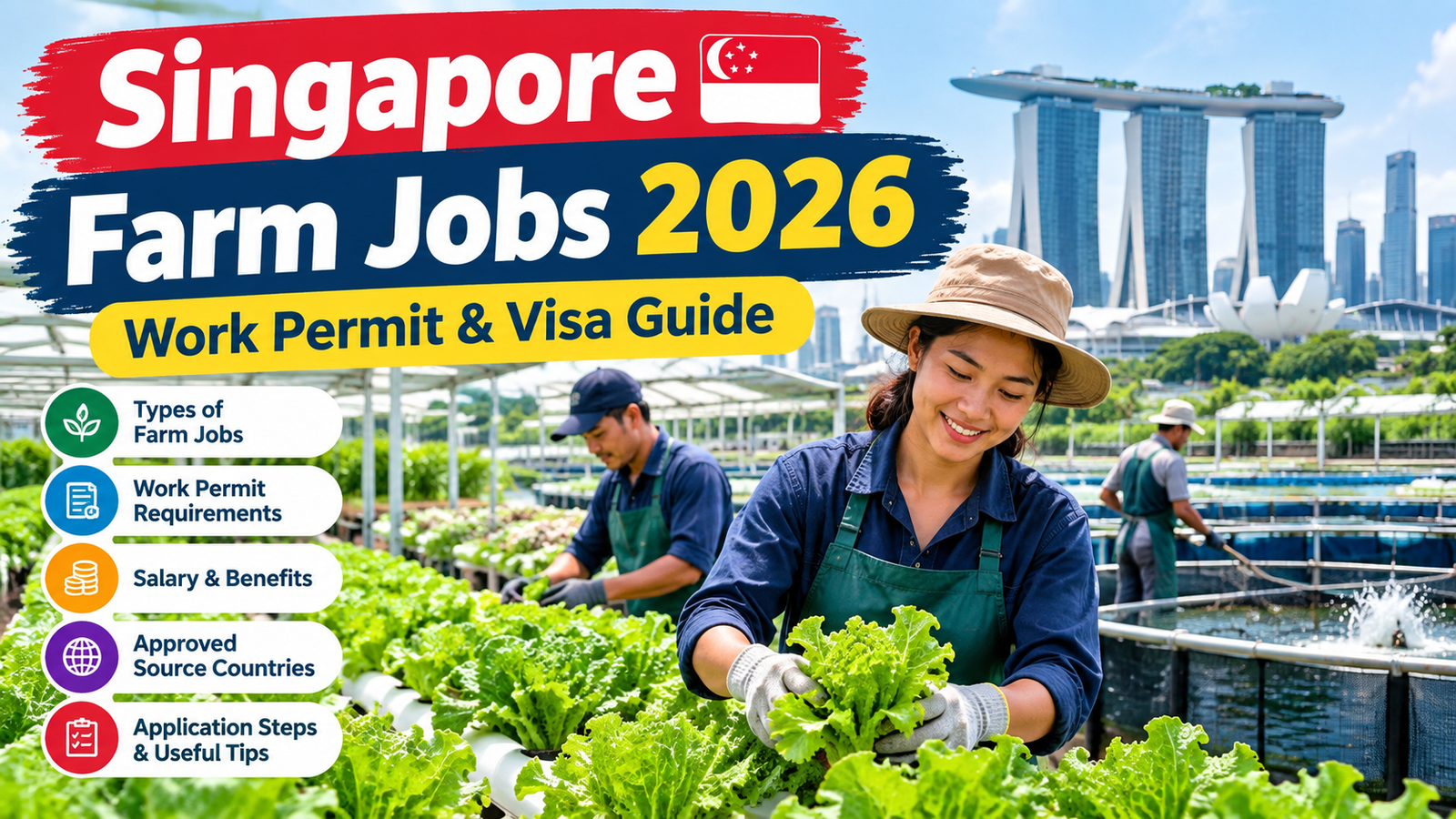
Singapore Farm Jobs 2026: Urgent Hiring with Work Permit & Visa Sponsorship
Are you seeking for this job ? Singapore may be better known for finance, technology and logistics than traditional agriculture, and but its agri-food sector includes vegetable farms, egg farms, fish farms, mushroom farms and increasingly technology-driven indoor farming operations. For international job seekers, and this creates interest in Singapore farm jobs 2026, particularly positions advertised with the employer-sponsored Work Permits.
There is an most important point applicants should understand before applying: Singapore does have an Agritech Work Permit Scheme, and but eligibility is controlled by the employer’s business, the type of farming activity, Singapore’s foreign-worker rules and the worker’s approved source country. It is therefore not accurate to the assume that every farm vacancy is open to applicants from every country. The Singapore Food Agency (SFA) states that big companies performing farming activities can apply for Work Permits under the Services sector, and while licensed food farms can qualify for the Agritech Work Permit Scheme.
This guide full explains how Singapore farm jobs work in 2026, typical some duties, potential salaries, Work Permit requirements, approved source countries, and application steps, documents, benefits and ways to verify an opportunity before paying any recruitment-related the costs.
Overview of Singapore Farm Jobs 2026
Singapore’s farming industry is relatively small compared with the country’s overall economy, but it plays a role in local food production and food-security planning. The sector includes land-based farms, indoor farms, vegetable production, egg production and aquaculture. SFA describes local farms as increasingly adopting technology and controlled-environment production methods because Singapore has limited agricultural land.
For overseas workers, the most relevant opportunity is not simply a generic “farm visa.” Instead, a qualifying farm employer must use the appropriate employment and Work Permit arrangements. SFA’s current guidance states that companies performing farming activities can apply for Work Permits under the Services sector. Licensed food farms can also qualify for the Agritech Work Permit Scheme, under which foreign workers must perform farming-related the work such as cultivating food crops, rearing animals for a food, or related farming activities.
This distinction matters because an the advertisement saying “Singapore farm jobs with visa sponsorship” does not automatically mean that an the applicant qualifies. The employer, occupation, farm licence, Work Permit category and nationality all need to fit the applicable rules.
Singapore’s farms also range from traditional agricultural operations to highly automated indoor and technology-based facilities. Consequently, job descriptions can vary considerably. Some vacancies may involve physical farm work, while others require technical, machinery, aquaculture or agricultural skills.
Key Highlights of Singapore Farm Jobs 2026
- Singapore has a specific Agritech Work Permit Scheme for eligible food-farming businesses.
- Qualifying workers may perform crop cultivation, animal rearing and related food-farming activities.
- The employer, rather than the worker, normally submits the Work Permit application to Singapore’s Ministry of Manpower (MOM).
- The current Agritech scheme includes approved source countries and regions, and the list does not include every nationality.
- Malaysia, PRC, Hong Kong, Macau, South Korea and Taiwan are included, along with specified Non-Traditional Sources such as Bangladesh, India, Sri Lanka, Thailand, Myanmar, the Philippines, Bhutan, Cambodia and Laos.
- Farm workers should verify the actual employer and Work Permit route before paying an agent.
- Salary varies according to occupation, experience, skills, employer and contract terms.
- A job advertisement should not be treated as proof that a Work Permit will be approved.
What Is the Agritech Work Permit Scheme?
The Agritech Work Permit Scheme is particularly relevant to foreign workers interested in Singapore’s food-farming sector. SFA explains that licensed food farms can qualify for the scheme, while foreign workers employed under it are restricted to farming-related work.
The scheme covers activities connected with food production. Depending on the farm, this can include growing crops, tending plants, feeding and caring for food-producing animals, aquaculture-related activities and other duties directly associated with farming.
This is important because a worker should not assume that a Work Permit obtained for a farm can simply be used for another unrelated occupation. MOM’s Work Permit conditions state that the worker is permitted to work for the employer and in the specified occupation.
The employer also has responsibilities. MOM requires employers of Work Permit holders to comply with conditions involving salary, accommodation, medical insurance and other employment obligations.
In practical terms, “visa sponsorship” in many online job advertisements should be understood as employer-supported Work Permit processing, rather than a promise that an applicant will automatically receive permission to work.
Types of Singapore Farm Jobs in 2026
Farm Worker
Farm workers may perform routine agricultural tasks such as a planting, harvesting, watering, cleaning growing all areas, or handling produce and maintaining farm facilities. Physical fitness can be important because the work may involve the standing, lifting, repetitive movements and the outdoor or controlled-environment all conditions.
Vegetable Farm Worker
Vegetable farms can require workers to the prepare growing areas, plant seedlings, or monitor crops, harvest vegetables and a sort produce. Technology-intensive farms may also use hydroponic, vertical or a controlled-environment systems.
Livestock and Poultry Worker
Animal-related farms can require feeding, cleaning, or monitoring animal health, maintaining equipment and following very strict hygiene procedures. Workers need to follow workplace instructions carefully because food production requires attention to sanitation and the biosecurity.
Aquaculture Worker
Singapore has a significant aquaculture component within its the local agri-food sector. Aquaculture jobs can involve feeding fish, monitoring water conditions, or maintaining tanks or cages, handling stock and a assisting with harvesting and packing.
Farm Technician
Technical roles can involve machinery, sensors, irrigation systems, environmental controls, electrical systems or other agricultural technology. These positions may require relevant qualifications or previous experience.
Farm Supervisor
Supervisory positions usually involve coordinating workers, monitoring production all activities, maintaining records and ensuring that the operational procedures are followed. Such jobs generally require more good experience than basic farm-worker positions.
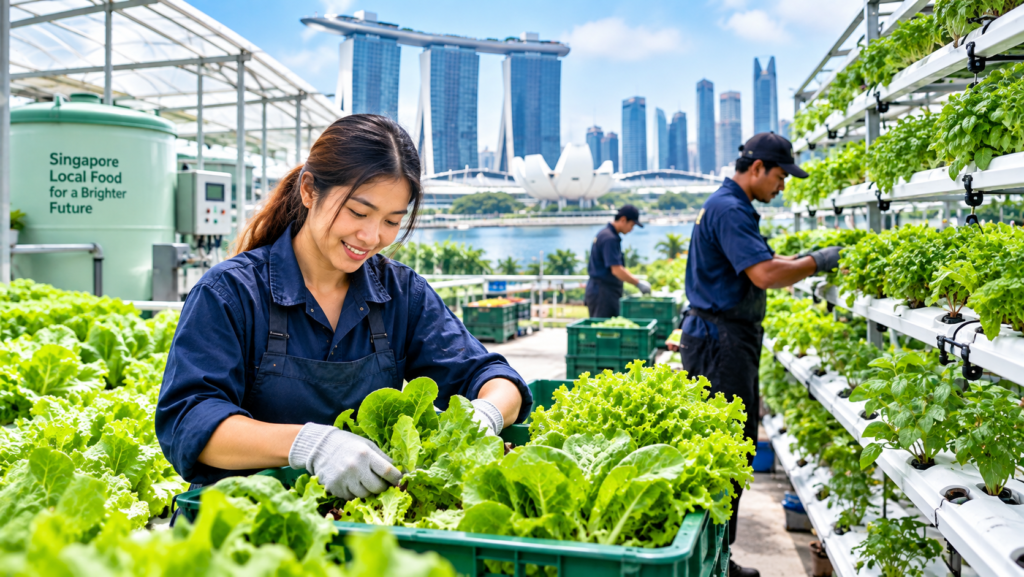
Singapore Farm Worker Salary Expectations
Salary is one of the most searched topics when people investigate overseas agricultural employment. However, applicants should be careful with advertisements showing unusually high salaries without explaining the occupation, working hours, overtime, accommodation deductions or employment conditions.
SFA’s published agri-food career information provides useful reference figures. Its career map lists a historical starting range of around S$1,600–S$2,000 for farm workers, based on 2023/24 MyCareersFuture opportunities. It also lists approximately S$1,600–S$1,800 for post-harvest workers or packers and higher ranges for drivers, technicians and professional roles. These figures are reference information rather than a guaranteed 2026 salary for every vacancy.
A worker’s actual package can depend on experience, skills, job responsibilities, employer, overtime arrangements and other contractual terms. Candidates should therefore ask for a written offer showing the basic monthly salary, working hours, overtime arrangements, rest days, accommodation arrangements and deductions before accepting a position.
MOM also states that the Work Permit itself does not have a general minimum qualifying salary in the way some professional work passes do, but employers must pay the fixed monthly salary declared to MOM.
The safest approach is to compare the complete employment package, not simply the headline salary.
Work Permit and Visa Sponsorship Requirements
Foreign nationals who intend to work in Singapore need an appropriate valid work pass before beginning employment.
For eligible farm employment, the employer or an appointed employment agency handles the Work Permit application. MOM says employers or appointed employment agents can submit Work Permit applications online. For most applications, processing is stated as being within one week, although some cases can take longer.
General requirements can include:
- A qualifying employer
- An eligible farming business or activity
- An eligible occupation
- An approved source country or region
- A valid passport
- Compliance with applicable Work Permit conditions
- Medical insurance arranged by the employer
- Required security bond arrangements where applicable
- Employer compliance with foreign-worker quota and levy rules
MOM explains that Work Permit requirements vary according to sector and that employers need to meet requirements involving areas such as quota, levy, medical insurance and security bonds.
The Work Permit is normally issued for up to two years, although the actual validity can be shorter depending on factors including passport validity, security bond and employment period.
Approved Source Countries for Singapore Farm Work
This is one of the most important sections for international applicants.
According to SFA’s current information, the Agritech Work Permit Scheme allows farms to employ foreign workers from:
- Malaysia
- People’s Republic of China
- Hong Kong
- Macau
- South Korea
- Taiwan
- Bangladesh
- Bhutan
- Cambodia
- India
- Laos
- Myanmar
- Philippines
- Sri Lanka
- Thailand
SFA’s page was new updated on 3 September 2026, so applicants should use the latest official information rather than relying on the old recruitment advertisements.
Important some Point for Pakistani Applicants
If you are applying from Pakistan, pay particular attention to the source-country all rules. Pakistan is not listed among the approved source countries or the regions shown by SFA for the Agritech Work Permit Scheme as of the latest published information.
That means a Pakistani applicant should not assume that an the advertisement claiming “Singapore farm visa sponsorship from Pakistan” represents an eligible route. The applicant should independently verify whether the specific employer and a job fall under a different lawful work-pass category before the proceeding.
This is especially very important because online advertisements can use broad terms such as “Singapore visa sponsorship” even when the advertised position does not the actually have an available Work Permit route for the applicant’s nationality.
Who Can Apply for Singapore Farm Jobs?
The first question is not simply whether someone has farming experience. Eligibility depends on the particular job and immigration route.
Applicants should generally consider the following:
Nationality
The worker’s source country must be permitted under the relevant Work Permit scheme. The Agritech scheme has a defined list.
Experience
Some basic farm jobs may accept applicants with limited experience, while technician, machinery, aquaculture and supervisory roles can require specific experience or qualifications.
Physical Capability
Farm work can involve very long periods of standing, repetitive tasks, lifting, cleaning and a exposure to farm environments.
Job-Specific some Skills
Technology-based farms may prefer workers familiar with the irrigation systems, crop monitoring, machinery, aquaculture equipment or the controlled-environment agriculture.
Valid Documents
A valid passport and accurate personal all information are essential for the Work Permit new process.
Step-by-Step Guide to the Applying 2026
Find a Genuine Vacancy
Look for farm vacancies through reputable recruitment channels, employer websites and Singapore’s official employment resources. SFA says it supports job matching for the agri-food sector through MyCareersFuture and provides career information for job seekers.
Check the Employer
Confirm the company’s legal identity, business activity and whether it actually operates a qualifying farm.
Verify the Job Description
Make sure the position genuinely involves the duties stated in the advertisement. A job advertised as “farm worker” should not suddenly become construction, factory or unrelated domestic work after arrival.
Receive Written Employment Terms
Before travelling, request a written offer or the employment contract. Check salary, working hours, rest days, good accommodation, deductions, overtime and a job location.
Employer Applies for the Work Permit
The employer or appointed employment agent submits the application to MOM.
Check the IPA Details
If approved, the worker receives an a In-Principle Approval (IPA) arrangement through the employer. MOM specifically advises checking that the worker’s IPA particulars match the passport details.
Documents You May Need
The exact document list depends on the employer and a application, but applicants should be prepared to the provide:
- Valid passport
- Passport photographs where required
- Updated CV or résumé
- Employment history
- Educational or technical certificates, if relevant
- Previous agricultural experience records
- Medical documents when required
- Signed employment documentation
- Work Permit-related information requested by the employer or appointed agent
Never provide false certificates or inaccurate employment history. False information can create serious immigration and employment problems.
Benefits of Working on a Singapore Farm
A genuine farm position can provide international work experience and exposure to Singapore’s modern agri-food industry. Workers may gain experience in crop production, aquaculture, controlled-environment agriculture, food production systems or agricultural technology.
Another potential benefit is the structured nature of Singapore’s Work Permit system. Employers have obligations concerning workers’ salaries, accommodation and medical insurance. MOM states that employers must provide proper housing and maintain medical insurance for Work Permit holders.
Some farms may also provide on-site accommodation. MOM specifically recognises Workers’ Quarters at Farms (WQFs) as accommodation for workers who work and reside on farm premises, subject to the applicable requirements.
However, benefits vary from employer to employer. Free accommodation, meals, transport or the overtime should never be the assumed unless the employment contract specifically states them.
Frequently Asked Questions
Are Singapore farm jobs available with Work Permit sponsorship in 2026?
Yes, Singapore has an Agritech Work Permit Scheme through which eligible farms can employ foreign workers. SFA states that companies performing farming activities can apply for Work Permits under the Services sector, while qualifying licensed food farms can use the Agritech Work Permit Scheme.
Can Pakistani workers apply directly for Singapore farm jobs?
The latest SFA source-country list for the Agritech Work Permit Scheme does not include Pakistan. Therefore, Pakistani applicants should not assume that a standard Singapore farm Work Permit is available to them. Any advertised alternative route should be independently verified against current MOM requirements.
How much does a Singapore farm worker earn?
SFA’s published career information gives a historical starting reference of approximately S$1,600–S$2,000 for farm workers, based on 2023/24 MyCareersFuture opportunities. Actual 2026 salaries vary by employer, role, experience and contract conditions.
Who applies for the Singapore Work Permit?
The employer or an appointed employment agent applies for the Work Permit through MOM. The worker generally does not independently submit the employer’s Work Permit application.