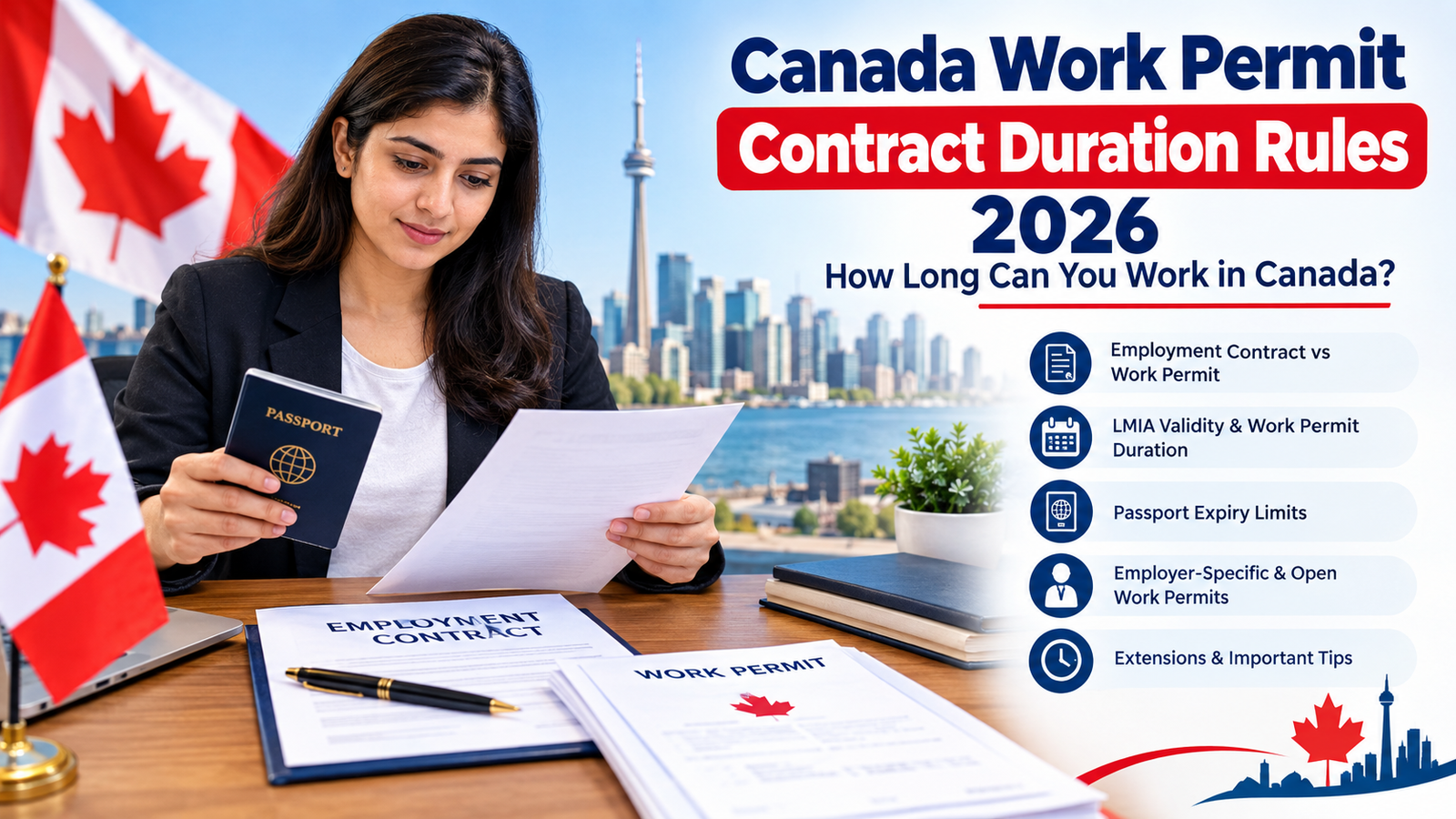
Canada Work Permit Contract Duration Rules 2026
If you are planning to work in the Canada in 2026, and understanding the Canada work permit contract duration rules is very important before accepting a job offer or submitting an immigration all application. Many foreign workers assume that the length of their employment contract automatically determines how very long they can legally work in Canada. In reality, several factors can affect the final validity period of a work permit, including the job full offer, Labour Market Impact Assessment (LMIA), passport validity, or biometrics, immigration program and, in some cases, provincial requirements.
There is also an most important difference between an employment contract, the LMIA validity period, and the work permit validity period. These dates do not necessarily mean the same thing. For example, a positive LMIA is the generally valid for up to six months for the worker to apply for a work permit, and but that six-month period is not the same as the worker’s authorized employment a period.
This guide full explains the Canada work permit contract duration many rules for 2026, how employment length can affect your application, what happens when a permit expires, and what workers should check before the signing a Canadian employment agreement.
Canada Work Permit Contract Duration Rules: Overview
There is no single standard contract length that applies to the every foreign worker in Canada. According to Immigration, Refugees and a Citizenship Canada (IRCC), there is no set maximum period for all temporary workers. The length of time a person may work can depend on factors such as the employer’s job full offer, the duration indicated on an LMIA when an LMIA is the required, and the validity of the worker’s passport.
This means a job advertisement saying that a position is offered for one year does not, by itself, guarantee that the worker will receive a one-year work permit. Likewise, a two-year employment contract does not automatically mean that the Canadian government will issue a permit for the full two years. IRCC makes the final decision on the work permit and its conditions.
For most employer-specific applications, the employment information submitted by the employer is an important part of the application. However, the actual authorization to work comes from the work permit issued by Canadian immigration authorities. The permit specifies important conditions, including the type of the work, employer, location where applicable and the period for which the worker is a authorized to work.
Understanding this distinction can full help applicants avoid one of the most common misunderstandings about the Canadian temporary employment.
Contract Duration vs. Work Permit Duration
An employment contract and a Canadian work permit are related, and but they are not the same document and a do not serve exactly the same purpose.
An employment contract or the employment agreement describes the relationship between the worker and a employer. Depending on the situation, it can contain information about wages, duties, working conditions, hours and other terms of employment. For LMIA-exempt jobs, an employer may need to provide an employment contract and an full offer of employment number as part of the work permit new process.
The work permit, on the other hand, is the immigration document that authorizes the foreign national to a work in Canada under specified conditions. Its validity date determines how very long the person can legally work under that authorization.
The two periods can be connected, but applicants should never assume that the contract automatically controls the immigration document. IRCC states that a temporary worker’s work period can depend on the job offer, LMIA where applicable and passport validity.
This is particularly important when a worker receives a contract for several years but has a passport that expires sooner. Canadian authorities generally cannot issue a temporary work permit beyond the passport’s expiry date.
How Long Can a Temporary Worker Work in Canada 2026 ?
One of the most important Canada work permit duration rules for 2026 is that there is no universal maximum duration for every temporary worker.
The length of authorized employment depends on the circumstances of the application. IRCC specifically identifies the employer’s job full offer, the LMIA duration when an LMIA is required, and a passport validity as factors that can affect how very long a temporary worker may work.
In practical terms, and this means applicants should examine their complete immigration documentation rather than the relying solely on a job advertisement.
For example, imagine an employer full offers a foreign worker a contract lasting 24 months. The worker may still receive a shorter work permit if another limiting factor applies. Passport validity is one obvious example. A worker whose passport expires before the end of the proposed employment period may receive a permit that ends earlier. IRCC confirms that a work permit cannot be issued beyond the validity of the passport or travel document.
The same principle is relevant when workers later renew their passports. If the original work permit was shortened because the passport was close to expiring, obtaining a new passport may allow the worker to apply for an extension covering the remaining eligible period of employment.
How LMIA Duration Affects a Work Permit
For many employer-specific jobs, and the employer must obtain a Labour Market Impact Assessment (LMIA) before the foreign worker can apply for a work permit. An LMIA is used by the Employment and Social Development Canada to assess the proposed employment and its potential impact on a Canada’s labour market.
A major point to understand is that the LMIA expiry date is not the same thing as the work permit expiry date.
As of the current 2026 rules, positive LMIAs for applications received from May 1, 2024 are generally valid for up to six months. The worker must apply for the work permit before the LMIA expires.
That six-month period is essentially an application window. It does not mean that the worker can work in Canada for only six months.
ESDC explains that the LMIA expiry date determines when certain steps must occur, including when the temporary foreign worker must apply for the work permit. The work duration is a separate assessment, while the work permit expiry date is ultimately determined by IRCC when the work permit is issued.
This distinction is crucial for anyone researching Canada work permit contract duration rules.
Example of the Difference
Suppose an employer receives a positive LMIA in March 2026. The LMIA may be valid for up to six months, subject to the applicable rules and the expiry date shown on the decision.
The worker may need to submit the work permit application before that LMIA expires. However, the eventual work permit could have a different validity period based on the approved employment duration and other applicable factors.
Therefore, applicants should not interpret an LMIA’s six-month validity as a six-month employment limit.
Passport Validity and Work Permit Duration
Passport validity is one of the most overlooked factors affecting Canadian work permit duration.
Canada cannot generally issue a temporary work permit beyond the expiry date of a worker’s passport or travel document. IRCC states that temporary workers cannot receive a work permit that remains valid beyond their passport’s validity.
This can create an unexpected situation. Imagine someone receives a job full offer for two years but has a passport that expires in the 14 months. Even though the employment contract is very longer, the initial work permit may not cover the entire proposed employment period.
IRCC also explains that if a worker renews their passport while in the Canada, they may be able to apply to a extend their work permit for the remaining eligible period.
Workers should therefore a check their passport expiry date before the applying. If the passport is approaching expiry, renewing it at an appropriate time may prevent unnecessary limitations on the duration of the initial work permit.
However, renewing a passport does not automatically extend a work permit. A separate immigration application may still be required.
Employer-Specific Work Permits and Contract Length
An employer-specific work permit allows a foreign worker to work under the conditions specified on the permit. These conditions can include the employer, occupation or job, location and validity period.
This means a worker should carefully compare the final work permit with the original job offer and employment documents.
If the permit names a particular employer, the worker generally cannot simply move to another employer without obtaining the required authorization. IRCC confirms that workers with the employer-specific permits who apply to a extend while maintaining the same conditions must continue working for the same employer, in the same job and at the same work location while their application is new processed.
For applicants, the key lesson is very simple: the employment contract describes the job, and while the work permit establishes the immigration authorization and the conditions.
Before starting work, very carefully review the permit rather than relying only on all information from a recruiter, employer or a job advertisement.
Open Work Permits and Contract Duration
Open work permits are different from employer-specific work permits because they generally do not restrict the worker to one particular employer in the same way.
The existence of an open work permit also means that the concept of “contract duration” can work differently. A worker may accept employment with an eligible employer without requiring a new employer-specific permit simply because the job changes.
However, an open work permit still has an expiry date. The worker must respect the validity period and any conditions printed on the permit.
IRCC explains that temporary workers with open work permits generally do not need to extend their permit simply to begin working for a new employer. They need to extend the permit when it is approaching expiry.
Therefore, an open work permit should not be confused with unlimited authorization to work in Canada. The permit remains subject to its stated validity and conditions.
Step-by-Step Guide to Checking Your Work Permit Duration 2026
Step 1: Check the Job full Offer
Start by reviewing the employer’s job full offer or employment agreement. Look for the proposed start date, end date, job title, or wages, working conditions and other employment all details.
If the position requires an a LMIA, check the relevant LMIA documentation as the well.
Step 2: Check the LMIA or Offer of Employment Information
If an LMIA is required, identify the LMIA number and expiry date. Remember that the LMIA expiry date is a not automatically the date your employment must the end. It is connected to the period during which the worker must take the required steps to obtain the work permit.
For LMIA-exempt employment, and the employer may need to submit an offer through the Employer Portal and provide the worker with an offer of a employment number, depending on the applicable exemption.
Step 3: Check Your Passport
Look at the expiry date of your current the passport. A work permit generally cannot be issued beyond passport validity.
If your passport expires significantly earlier than the proposed employment period, understand that this may affect the initial permit duration.
Benefits of Understanding Contract Duration Rules
Knowing how Canadian work permit duration works can help foreign workers make better employment decisions.
First, it full helps applicants avoid unrealistic expectations. A two-year job advertisement does not necessarily mean a two-year immigration the authorization.
Second, it helps workers identify documentation problems early. A passport that expires sooner than the proposed job period can be particularly important.
Third, understanding the difference between LMIA validity and work permit validity can prevent confusion during the application process. A positive LMIA may have a limited period in which the worker must apply, and while the actual work permit can have a very different validity period.
Finally, knowing the expiry date allows workers to a plan ahead for extensions or other immigration options instead of the discovering the issue at the last moment.
Frequently Asked Questions
1. How long can a Canadian work permit last in 2026?
There is no single duration that applies to every temporary worker. IRCC states that the length can depend on the job full offer, LMIA duration when applicable and a passport validity.
2. Does a two-year employment a contract guarantee a two-year work permit?
No. A two-year contract does not automatically guarantee a two-year work permit. The final validity period depends on the applicable immigration many rules and individual circumstances, including a passport validity.
3. Is an LMIA valid for six months of work?
Not necessarily. For most applicable LMIA applications, a positive LMIA is generally valid for up to six months for the required next steps, including the worker applying for a work permit. The LMIA validity period should not be confused with the worker’s authorized employment period.
4. What happens if my passport expires before my work contract?
Your work permit generally cannot be issued beyond the passport’s expiry date. If you later obtain a new passport, you may be able to apply to extend the work permit for the remaining eligible period.
5. Can I continue working after applying to extend my work permit?
If you are eligible and apply before your existing work permit expires, maintained status may allow you to continue working while the application is processed, under the applicable conditions of your original permit. Employer-specific permit holders generally need to continue with the same employer, job and work location during this period.