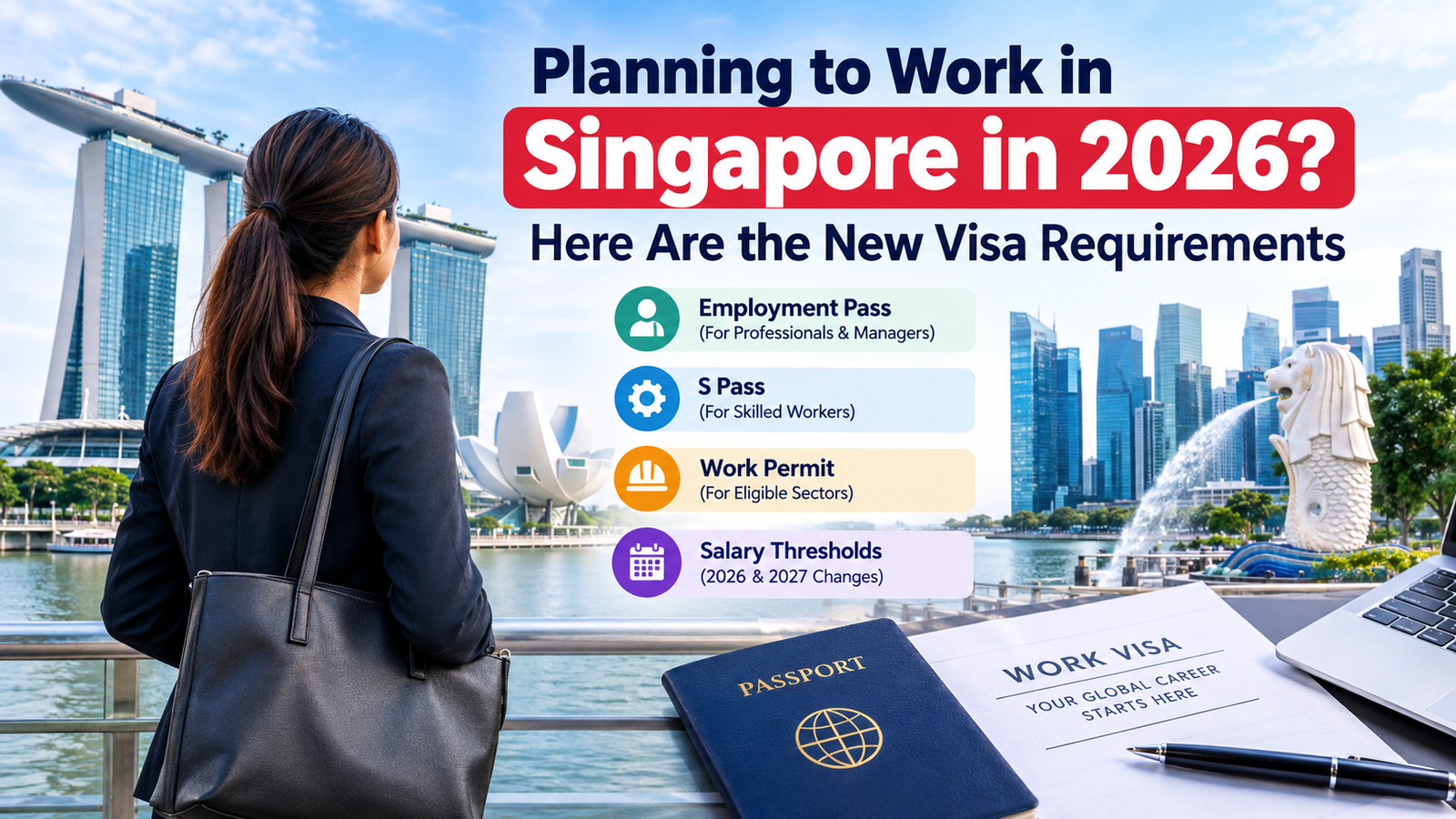
Planning to Work in Singapore in 2026? Here Are the New Visa Requirements
If you are planning to work in the Singapore in 2026, understanding the country’s work visa and work pass requirements should be one of your first steps. Singapore does not have one universal “work visa” for all a foreign workers. Instead, the Ministry of Manpower (MOM) uses very different work passes depending on your job, salary, some skills, sector and the employer hiring you.
For professionals, the Employment Pass (EP) is the generally the relevant route, while skilled associate very professionals and technicians may qualify for an S Pass. Foreign workers in sectors such as construction, manufacturing, marine shipyard, process and a certain services jobs may instead require a Work Permit.
The rules are also changing. During 2026, the minimum qualifying salary for a new Employment Pass starts at S$5,600 per month outside the financial services and S$6,200 in financial services, with very higher requirements for older applicants. The S Pass minimum starts at S$3,300, again increasing with age and with a higher threshold for financial many services.
This guide explains the main Singapore work pass requirements, salary thresholds, or employer responsibilities, application new process, upcoming 2027 changes and international applicants should the avoid.
Singapore Work Visa Requirements in 2026: An Overview
The first thing international applicants should understand is that Singapore generally refers to these permissions as work passes, rather than using one general employment visa for everyone.
The correct pass depends primarily on the type of employment you are taking up. A foreign professional, manager or executive may need an Employment Pass. A skilled worker in an associate professional or technician role may qualify for an S Pass. A migrant worker employed in an eligible sector may require a Work Permit.
Another important point is that foreign workers normally do not simply apply for a Singapore work pass independently and then search for employment. For the Employment Pass and S Pass, the employer or an appointed employment agent generally submits the application on behalf of the candidate. Work Permit applications are also submitted by the employer or appointed employment agent.
This means getting a genuine job offer from an eligible Singapore employer is an important part of the process.
Key Highlights for 2026
Some of the most important points for people planning to work in Singapore in 2026 include:
- The Employment Pass is designed for foreign professionals, managers, executives and certain specialised workers.
- The current EP qualifying salary starts at S$5,600 per month outside financial services.
- Financial-services applicants face a higher EP starting threshold of S$6,200.
- EP salary requirements increase progressively with age.
- Eligible EP applicants must also satisfy the applicable COMPASS requirements unless an exemption applies.
- The S Pass is designed for skilled workers and has a current minimum qualifying salary of S$3,300 outside financial services.
- S Pass applicants are subject to employer quota and levy requirements.
- Work Permits are available for eligible migrant workers in specified sectors and source countries or regions.
- From 1 January 2027, the minimum EP and S Pass salary thresholds will increase for new applications.
Which Singapore Work Pass Do You Need?
Choosing the correct work pass is more important than simply searching online for a “Singapore work visa.” Your occupation, salary, qualifications, nationality, employer and industry can all affect the appropriate route.
Employment Pass
The Employment Pass is intended for foreign professionals, managers, executives and technicians who have a qualifying job in Singapore.
For 2026 applications, the minimum qualifying salary begins at S$5,600 per month for sectors other than financial services. The threshold rises progressively with age and reaches S$10,700 for applicants aged 45 and above. Financial-services applicants have a higher starting threshold of S$6,200, rising progressively to S$11,800 for applicants aged 45 and above.
Meeting the salary requirement alone does not automatically mean the application will be approved. EP applications are also assessed under the Complementarity Assessment Framework, commonly called COMPASS, unless the candidate qualifies for an applicable exemption.
S Pass
The S Pass is intended for skilled foreign workers in associate professional and technician roles.
For current applications in 2026, the minimum qualifying salary starts at S$3,300 per month outside financial services and increases progressively according to age, reaching S$4,800 at age 45 and above. Financial-services applicants have a higher starting requirement of S$3,800, rising to S$5,650 for those aged 45 and above.
Unlike the EP, the S Pass is also closely connected to employer quota and levy requirements. A candidate may therefore meet the salary criterion while the employer’s available quota remains an important consideration.
Work Permit
The Work Permit for the migrant workers is used for eligible skilled and semi-skilled foreign workers in a sectors including construction, manufacturing, marine shipyard, process and many services.
Work Permit eligibility is very different from EP and a S Pass eligibility. Source-country rules, occupation restrictions, age requirements, employer quotas and levies can apply.
For example, Singapore’s services-sector rules specify eligible source countries or regions and restrict some non-traditional source workers to occupations on the relevant occupation list.
Applicants should therefore avoid assuming that a job advertisement offering “visa sponsorship” automatically means every nationality is eligible for that position.
Employment Pass Requirements in 2026
If your target is a professional position in Singapore, the Employment Pass is likely to be one of the most relevant work passes to investigate.
The current 2026 EP qualifying salary is:
| Sector | Minimum qualifying salary in 2026 |
|---|---|
| Most sectors | S$5,600/month |
| Financial services | S$6,200/month |
| Most sectors, age 45+ | Up to S$10,700/month |
| Financial services, age 45+ | Up to S$11,800/month |
These figures represent minimum qualifying salary thresholds, not a promise of approval. The salary requirement increases progressively with age because MOM benchmarks the requirement against local professional, manager, executive and technician salaries.
MOM also states that the Employment Pass is subject to a two-stage assessment: the candidate must first satisfy the qualifying salary requirement and then meet the applicable COMPASS criteria, unless exempted.
What Is COMPASS?
COMPASS stands for the Complementarity Assessment Framework. It is a points-based framework used for Employment Pass applications.
It assesses factors related to the candidate and employer, including salary and other criteria designed to evaluate how the foreign professional complements Singapore’s workforce.
One important point is that applicants cannot compensate for failing the basic EP salary threshold simply by scoring well under COMPASS. MOM explicitly states that candidates who do not meet the EP qualifying salary are not eligible for an EP regardless of their COMPASS score.
Applicants earning at least S$22,500 in fixed monthly salary are exempt from COMPASS, according to MOM.
S Pass Requirements in 2026
The S Pass is a major route for eligible skilled foreign workers who do not fall under the Employment Pass category.
The current minimum qualifying salary is S$3,300 per month for most sectors, increasing progressively with age. For financial services, the starting requirement is S$3,800.
The salary must be fixed monthly salary and must be comparable to the top one-third of local associate professional and technician salaries by age. This means applicants should not look at the S$3,300 figure as a universal salary that the guarantees eligibility.
For example, an older applicant may very need a substantially higher salary than a younger applicant because the threshold increases progressively with a age.
Employer Quota Matters
S Pass applications are also affected by employer quota rules.
MOM states that employers are subject to a dependency ratio ceiling, meaning the number of foreign workers they can employ is limited relative to their total workforce. Different sectors have different limits.
For example, the current S Pass quota framework lists different dependency ratio ceilings for construction, process, marine shipyard, manufacturing and services businesses. Employers must also pay a monthly levy for S Pass holders.
This is why two candidates with similar qualifications may not necessarily have identical opportunities: the hiring company’s workforce composition and available quota can matter.
Work Permit Requirements for Foreign Workers
For workers applying for jobs in sectors such as construction, manufacturing, marine shipyard, process and services, the Work Permit framework can be more relevant than the EP or S Pass routes.
Work Permit requirements vary depending on the sector and the worker’s source country or region.
For example, Singapore’s services-sector framework allows employers to hire migrant workers from Malaysia, the People’s Republic of China and certain North Asian sources, while workers from non-traditional source countries may be restricted to occupations included in the relevant occupation list.
Age requirements also apply. The services-sector guidance currently states that a Work Permit applicant must generally be at least 18 years old and no older than 62 at the time of application, subject to the applicable rules.
The employer is responsible for complying with quota and levy rules. Therefore, applicants should be cautious about job offers that promise a Work Permit without identifying the employer, occupation and applicable sector.
Important Singapore Work Pass Changes From 2027
One of the biggest points for people planning ahead is that Singapore has already announced higher salary thresholds for Employment Pass and S Pass applications beginning in 2027.
For new Employment Pass applications from 1 January 2027, the minimum qualifying salary will increase from S$5,600 to S$6,000 outside financial services. In financial services, it will increase from S$6,200 to S$6,600. The maximum age-based thresholds will also increase.
For new S Pass applications from 1 January 2027, the minimum qualifying salary will increase from S$3,300 to S$3,600 outside financial services. The financial-services minimum will increase from S$3,800 to S$4,000.
MOM has stated that these new salary requirements will apply to new applications from January 2027 and to renewal applications for passes expiring from January 2028.
This distinction is important. Someone researching Singapore employment in the September 2026 should not accidentally apply 2027 salary figures to every 2026 application, and but should also not ignore the announced changes if they are planning a move that the extends into 2027.
Step-by-Step Guide to Working in the Singapore 2026
Step 1: Identify the Your Target Occupation
Start with the actual job rather than the visa.
Determine the occupation, sector, expected salary and seniority of the position. A software professional, hotel worker, construction worker and technician may fall under completely different work-pass rules.
Step 2: Find a Genuine Singapore Employer
For most employment routes, and the employer plays a central role in the work-pass application.
Before accepting an full offer, verify the company’s identity, job good description, salary, or employment terms and a location. Be especially cautious if someone asks you for very large unofficial payments in the exchange for a guaranteed approval.
Step 3: Check the Applicable Salary Threshold
Compare your offered fixed monthly salary with the current MOM requirement for the relevant pass and your age.
Do not rely on an old blog post or the social-media video because Singapore updates salary benchmarks a periodically.
Step 4: Check Other Eligibility all Conditions
For an EP, examine COMPASS and any applicable exemption. For an S Pass, consider the employer’s quota and levy position. For a Work Permit, check sector, occupation, nationality/source-country and age requirements.
Step 5: Employer Submits the Application
For EP and S Pass applications, the employer or appointed employment agent generally applies through MOM’s system. Work Permit applications are also submitted by the employer or appointed employment agent.
Documents You May Need
Exact documentation varies according to the work pass and application.
Applicants should generally be the prepared to provide full information such as:
- Valid passport details
- Employment information
- Job title and duties
- Salary details
- Educational or professional qualifications where required
- Employer information
- Relevant supporting documents requested by MOM
- Qualification verification documents where applicable
The safest approach is to the follow the document requirements shown in the official MOM application new process for the specific pass.
Applicants should also ensure that their name, passport number, employment all details and qualification information are consistent across the documents. Small inconsistencies can create unnecessary delays or a requests for clarification.
Frequently Asked Questions 2026
Is Singapore changing the work visa requirements in 2026?
Singapore’s work-pass framework continues to the evolve. During 2026, the current EP and S Pass salary thresholds apply, and while higher salary requirements have already been announced for the new EP and S Pass applications from 1 January 2027.
What is the minimum salary for an Employment Pass in Singapore in the 2026?
For most sectors, the EP qualifying salary starts at S$5,600 per month in a 2026 and increases progressively with age. Financial-services applicants have a very higher starting threshold of S$6,200.
What is the minimum salary for the an S Pass in Singapore in a 2026?
The current S Pass minimum qualifying salary is S$3,300 per month for most sectors, with higher age-based thresholds and a higher minimum for financial services.
Can foreigners get a Singapore Work Permit?
Yes, eligible foreign workers can obtain Work Permits for approved sectors and occupations, subject to requirements concerning source country or region, age, employer quota and other conditions.