South Korea Manufacturing Jobs With Visa Sponsorship 2026: Requirements, Salaries, Visa Process and How to Apply
Are you seeking for this job ? Finding legitimate South Korea manufacturing jobs with the visa sponsorship in 2026 can be an attractive option for international workers who want to work abroad in a factories, production facilities, and electronics manufacturing, food processing, machinery, or automotive-related industries, and other manufacturing environments. However, overseas applicants very need to understand how South Korea’s foreign-worker system actually works before paying an agent, accepting an full offer, or the making travel arrangements.
For many non-professional manufacturing workers, the main legal route is the South Korea’s Employment Permit System (EPS) and the E-9 visa/status, rather than a conventional professional employment visa. South Korea’s Ministry of a Employment and the Labor explains that EPS allows eligible very small and medium-sized businesses that the cannot find sufficient local workers to the legally employ non-professional foreign workers.
In 2026, the Korean government planned an overall E-9 foreign-worker intake of the 80,000 workers, and while manufacturing continues to represent a major part of the system.
This guide full explains what manufacturing jobs may be available, who can qualify, how the EPS process works, what applicants should know about a wages, Korean-language all requirements, accommodation, contracts, and common recruitment scams. The goal is to give international job seekers a realistic roadmap rather than the make unrealistic promises about employment or a visa approval.
Overview of South Korea Manufacturing Jobs for Foreign Workers
South Korea has a very large and highly developed manufacturing sector covering electronics, machinery, automotive components, food products, chemicals, plastics, or metal products, textiles, furniture, precision equipment and other industrial goods. This creates employment opportunities at very different skill levels, although the availability of positions depends on a government quotas, employer demand, industry many rules and the applicant’s eligibility.
For international workers without professional qualifications, and the Employment Permit System (EPS) is particularly most important. The Korean government created EPS to provide businesses with access to foreign workers while establishing a regulated system for recruitment and employment. The system is intended to make the foreign-worker process more transparent and protect workers’ rights.
Manufacturing employers using EPS generally have to satisfy government requirements before hiring foreign workers. This means an overseas applicant normally cannot simply find any Korean factory online and independently obtain an E-9 visa. The employer, government employment system, sending-country process and immigration procedures all form part of the legal recruitment pathway.
For this reason, international applicants should treat claims such as “guaranteed Korea factory visa,” “instant E-9 approval,” or “pay us and your job is confirmed” with caution.
What Does “Visa Sponsorship” Mean in South Korea?
The phrase “visa sponsorship” is commonly used by international job seekers to describe a situation in which a Korean employer participates in the legal process required for a foreign worker to enter and work in South Korea.
For many manufacturing workers, this process is connected to EPS and the E-9 status. The employer does not simply hand the worker a visa. Instead, the recruitment process involves government authorization, an employment contract, visa-related documentation and entry procedures.
The official EPS process for general foreign workers includes Korean-language testing, creation of a job-seeker roster, employment contract arrangements, pre-employment education, entry into Korea and workplace placement.
This distinction is important because not every factory job advertised on social media is an E-9 opportunity. A genuine opportunity should fit an authorized employment route and involve the appropriate government procedures.
Professional or highly skilled manufacturing positions can involve different immigration categories depending on the occupation, qualifications and employer. Therefore, engineers, technical specialists and experienced professionals should check the immigration category applicable to their particular position instead of assuming that every manufacturing vacancy uses E-9.
Manufacturing Jobs Commonly Available to Foreign Workers
Manufacturing work can involve many different duties. The exact position depends on the factory, product, location, shift pattern and employer.
Common categories can include:
Production Worker
Production workers may assist with assembly, production-line operations, packaging, inspection or other repetitive manufacturing tasks. These jobs can involve standing for long periods and following detailed workplace procedures.
Assembly Worker
Assembly positions may involve putting together components or products according to factory instructions. Accuracy, concentration and the ability to follow safety procedures can be important.
Machine Operator
Some manufacturing workers operate or assist with machinery. Depending on the position, workers may receive workplace training before performing specific tasks.
Quality Inspection Worker
Quality-control duties can include the checking products for visible defects, measuring components or a following inspection procedures. Basic technical understanding can be useful.
Packaging Worker
Packaging positions may involve preparing finished goods for storage, transportation or shipment. Work can include labeling, packing and checking quantities.
Food Manufacturing Worker
Food-processing facilities can employ workers for production, preparation, packaging and related tasks, subject to applicable employment rules.
Metal, Plastic and Component Manufacturing
South Korea’s manufacturing sector includes businesses producing metal products, plastics, machinery components, furniture, electronics-related products and other industrial goods. The EPS system specifically lists numerous manufacturing categories among permitted areas.
Job titles and responsibilities should always be checked against the actual employment contract rather than relying only on an advertisement headline.
Read Also : Sweden Bus Driver Jobs With Visa Sponsorship 2026
2026 Employment Permit System and Manufacturing Opportunities
The 2026 foreign-worker program provides an important indication of the scale of the legal employment system. South Korea’s Ministry of Employment and Labor announced an E-9 quota of 80,000 workers for 2026.
The government also announced measures concerning foreign-worker supply and manufacturing, including changes intended to address labor shortages outside the capital region.
Manufacturing has been a particularly significant area within E-9 recruitment. For example, the Ministry announced that the third 2026 round of new E-9 employment permits included 9,020 manufacturing positions out of 12,630 positions across all listed industries in that round.
These figures do not mean that 9,020 jobs are continuously available to every applicant. They represent government allocation during a particular recruitment round. Quotas, schedules, eligible countries and employer demand can change.
The official EPS platform also identifies manufacturing businesses that may qualify to the employ foreign workers and provides information about employment limits.
Therefore, applicants should check the current EPS announcements and the authorized recruitment process for their country instead of the relying on old social-media posts.
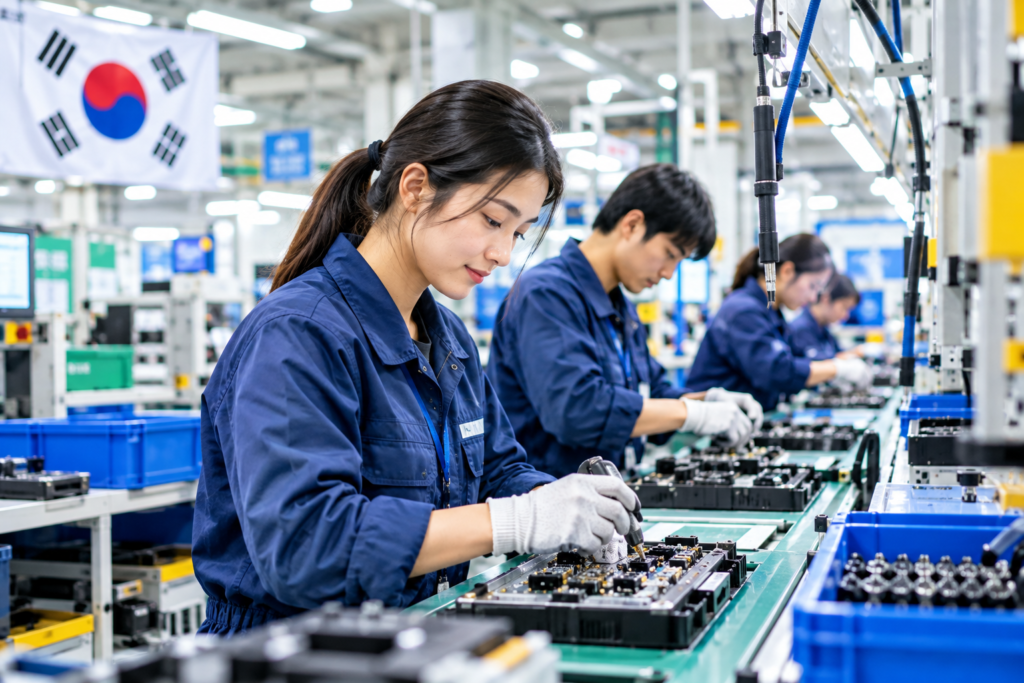
South Korea Manufacturing Job Salary in the 2026
Salary is one of the most important questions for the international applicants.
South Korea’s official 2026 minimum wage is a 10,320 Korean won per hour, with a monthly equivalent of 2,156,880 won based on the 209 hours. The Ministry of Employment and a Labor states that this minimum applies from January 1 through December 31, 2026.
This figure should be treated as a legal minimum reference, not a promise that the every manufacturing worker will a receive exactly the same total monthly income.
Actual earnings can differ depending on the employment contract, working hours, or overtime, night work, allowances, bonuses and the other legally applicable payments. Deductions can also a affect take-home pay.
For an overseas applicant comparing offers, it is better to ask for a complete breakdown rather than focusing on a large headline salary. Check:
- Basic hourly or monthly wage
- Normal working hours
- Overtime rate
- Night-shift arrangements
- Holiday work
- Bonuses, if any
- Accommodation costs
- Meals and meal deductions
- Transportation arrangements
- Insurance deductions
- Other legally permitted deductions
A recruitment advertisement claiming an unusually high salary without explaining working hours and deductions should be examined carefully.
Basic Requirements for E-9 Manufacturing Workers
Eligibility depends on the applicant’s nationality, recruitment program, current Korean immigration rules and other conditions. The official EPS system provides general requirements for applicants entering through the standard foreign-worker process.
The EPS information currently states that applicants generally need to be 18 to 39 years old, while some country-specific rules can differ. It also lists requirements concerning criminal records, previous forced removal from Korea, immigration restrictions and previous periods of stay under certain work statuses.
Applicants should therefore check the current requirements applicable to their own a country rather than assuming that all information from another country automatically applies to them.
Physical ability can also matter because factory work may involve the standing, lifting, repetitive movements, machinery, heat, protective equipment or a shift work. Applicants should understand the actual duties before accepting a position.
Employers may also have job-specific requirements. For example, technical positions may require previous experience, while entry-level production work may place greater emphasis on basic communication, reliability and the ability to follow safety instructions.
Korean Language Requirement and EPS-TOPIK
One of the most important parts of the EPS pathway is the EPS-TOPIK, the Korean-language proficiency test used in the foreign-worker selection process.
The official EPS information says the test evaluates basic communication skills needed for life in Korea, industrial safety knowledge and understanding of Korean culture. The stated selection process uses scores and other criteria, rather than treating the test as a simple pass-and-automatic-job system.
The EPS page currently describes a selection threshold of 80 points out of 200, with higher-scoring applicants selected according to the applicable process. It also states that the test result is valid for two years after announcement.
Learning Korean before applying can therefore be useful even beyond the formal test. Factory workers need to understand safety instructions, signs, workplace rules and basic communication with supervisors and colleagues.
Applicants should focus on the practical Korean vocabulary related to numbers, time, all tools, machinery, safety, directions, workplace instructions and a common daily situations.
Documents International Applicants May Need
The exact document list depends on the applicant’s country and stage of the recruitment. Documents can include identification, passport all information, photographs, application forms, testing records, health-related documents and the employment paperwork.
Applicants should not prepare all documents based solely on a private agent’s checklist. Requirements can change, and some documents may very need specific formats or validity periods.
Before submitting anything, confirm the instructions from the authorized government or a EPS-related authority in your country.
Keep copies of most important documents and contracts. If someone asks you to submit a passport or original document permanently without a clear legal reason, ask for an explanation and a verify the request with the relevant authority.
Benefits of Working in the South Korean Manufacturing 2026
Legal employment in South Korea can provide international workers with the opportunity to gain overseas work experience and earn income under a regulated employment framework.
One important advantage of the EPS system is that it is government-administered rather than being an entirely private recruitment market. South Korea’s Ministry of Employment and Labor says the system was designed to address labor shortages while protecting the domestic labor market and improving transparency in foreign-worker recruitment.
Workers may also have access to legally required workplace protections and insurance arrangements. The EPS platform provides information about insurance and benefits applicable to foreign workers.
Another potential benefit is professional and practical experience in a highly industrialized economy. Workers may gain experience with production new systems, quality procedures, machinery, workplace safety and a modern manufacturing environments.
However, these benefits should be considered alongside the realities of the factory employment, including shift schedules, repetitive work, physical high demands, language barriers and living away from family.
Read Also : Sweden Bus Driver Jobs With Visa Sponsorship 2026
Accommodation, Insurance and Working all Conditions
Accommodation is an important issue for overseas applicants.
Some employers may provide accommodation or offer employer-arranged housing, while others may apply a permitted deduction or require workers to make their own arrangements. These details should be confirmed in the employment documentation.
Never assume that the phrase “free accommodation” in a social-media advertisement means that all housing-related costs are covered.
Insurance is another important part of the Korean employment system. The EPS platform provides information about insurance and benefits for foreign workers.
Workers should understand what deductions appear on their payslips and a ask questions if an amount is unclear.
Working conditions can also vary substantially between the factories. Before accepting a position, find out whether the work involves day shifts, rotating shifts, or night work, overtime, standing, lifting, machinery or exposure to heat and a noise.
Frequently Asked some Questions
Are South Korea manufacturing jobs available to the foreign workers in 2026?
Yes. South Korea continues to operate the Employment Permit System for a eligible foreign workers, and manufacturing is one of the major sectors covered by the system. The government set the 2026 E-9 foreign-worker quota at the 80,000.
What visa is commonly used for the factory workers in South Korea?
Many non-professional foreign manufacturing workers enter through the E-9 employment route under the Employment Permit System. Professional manufacturing positions may fall under different immigration categories depending on qualifications and the job.
Do I need to know Korean to apply?
For the standard EPS route, Korean-language testing is an important part of the selection process. EPS-TOPIK evaluates basic communication, industrial safety knowledge and Korean cultural understanding.
Can an agent guarantee a South Korean manufacturing visa?
No private person should be trusted simply because they claim to guarantee approval. Legal employment depends on eligibility, government procedures, employer selection and immigration requirements. Applicants should verify recruitment information through official channels.