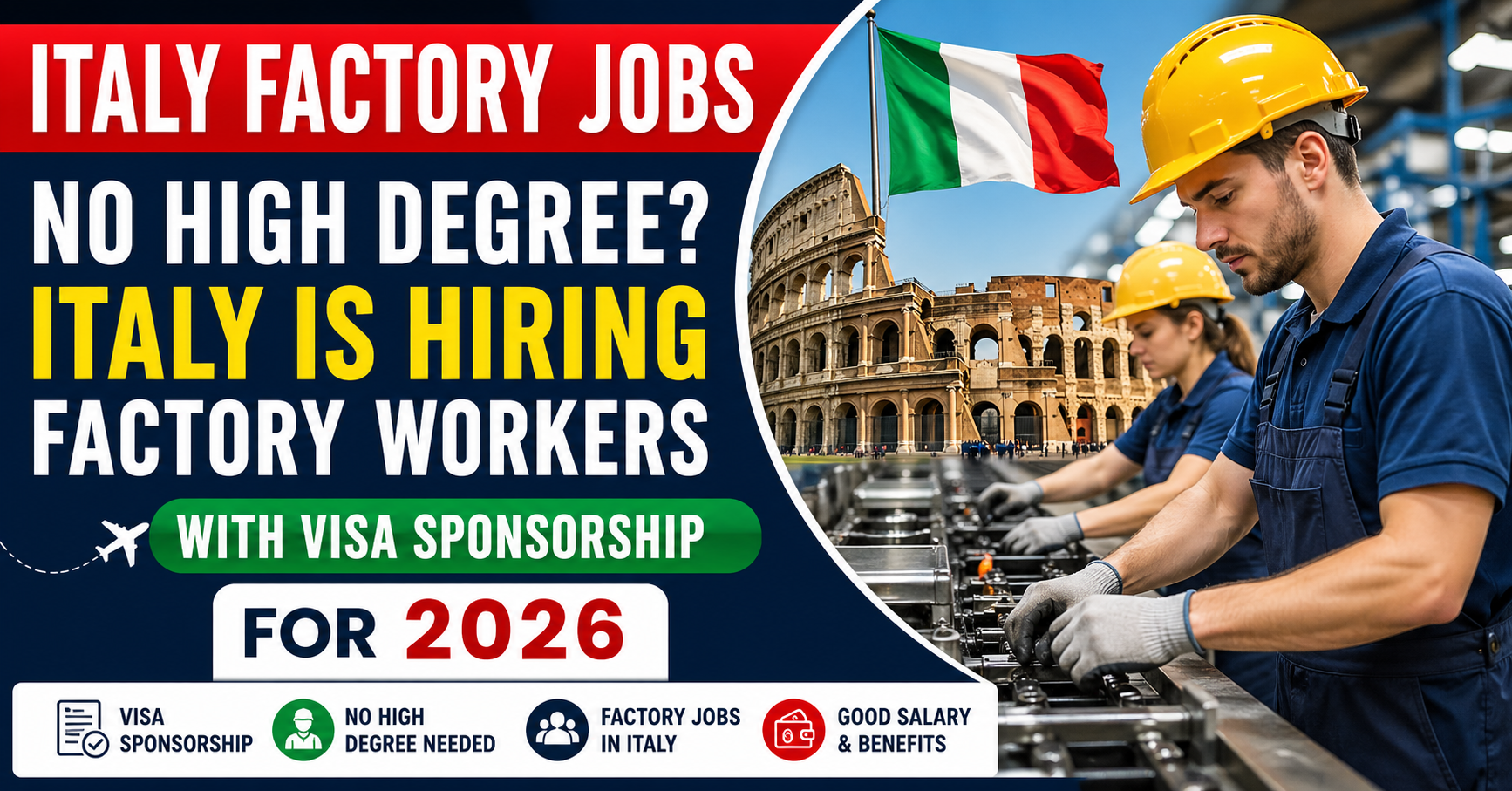
Italy Factory Jobs 2026 – No High Degree Required? Complete Visa Sponsorship Guide for Foreign Workers
The global job market is evolving rapidly, and Europe remains one of the most attractive destinations for the foreign workers seeking stable employment opportunities. Among European countries, and Italy continues to stand out due to its strong manufacturing sector, labor shortages, and increasing demand for foreign workers in entry-level positions.
In 2026, many online searches are focused on terms very like “Italy factory jobs with visa sponsorship,” “no degree jobs in Europe,” and “work in Italy without experience.” While these opportunities do exist, it is very important to understand the real system behind recruitment, or legal visa processes, salary expectations, and risks involved.
This guide provides a complete, or honest, and Google Discover–optimized breakdown of Italy factory jobs in 2026, including how they work, and how to apply, and what realistic expectations should be.
Why Italy is urgently Hiring Factory Workers in 2026
Italy is one of Europe’s major industrial economies, but it is currently facing a structural workforce shortage. This is one of the main reasons foreign workers are a being recruited.
1. Aging Workforce Crisis
A large portion of Italy’s population is the aging, and fewer young workers are entering physical labor industries such as manufacturing, logistics, and production. This creates a gap that companies are a struggling to fill.
2. Demand for Foreign Labor
To maintain productivity, and Italian industries are increasingly relying on foreign workers. These include roles in:
- Manufacturing plants
- Packaging industries
- Food processing all factories
- Warehousing and logistics centers
3. Expansion of the Industrial Output
Italy’s export-driven economy requires continuous production in automotive parts, or textiles, machinery, and food industries. This constant demand increases the need for factory workers.
4. Seasonal and Contract-Based Work
Many factory roles in the Italy are seasonal or contract-based, and meaning companies regularly hire new workers depending on production cycles.
Types of Factory Jobs Available in Italy 2026
Factory work in Italy is diverse and covers several industries. Below are the most common job all roles available to foreign workers.
1. Production Line Worker
This is the most common entry-level a factory job.
Responsibilities include:
- Assembling the products
- Operating basic machines
- Packaging goods
- Monitoring the production flow
2. Warehouse Worker
Warehouse jobs are essential for a logistics and supply chains.
Tasks include:
- Loading and the unloading goods
- Sorting packages
- Inventory management
- Preparing all shipments
3. Food Processing Worker
Italy has a large food industry, and especially in pasta, dairy, and packaged goods.
Responsibilities:
- Food packaging
- Quality control a checks
- Hygiene maintenance
- Machine-assisted processing
4. Textile Factory Worker
Italy is also known for its the textile and fashion production industry.
Tasks include:
- Fabric cutting and a handling
- Machine operation
- Sewing assistance
- Material inspection
5. Machine Operator Assistant
Some factories urgently hire workers to assist skilled operators.
Duties:
- full Supporting machinery operation
- Basic maintenance assistance
- Monitoring the production efficiency
Salary of Factory Workers in the Italy (2026
Salary depends on location, or company size, and experience level.
- Entry-level workers: €1,200 to €1,600 per month
- Skilled factory workers: €1,700 to €2,200 per month
- Overtime pay: Extra compensation based on a contract
- Additional Benefits (Varies by a Employer)
Some employers may provide:
- Accommodation assistance
- Transportation full support
- Paid holidays
- Health insurance coverage
However, these benefits are not guaranteed in the every job offer.
Italy Work Visa and Sponsorship System Explained
Italy has a structured immigration system that the regulates foreign worker entry.
What is Decreto Flussi?
Decreto Flussi is Italy’s annual immigration quota system that determines how many non-EU workers can legally enter the country for a employment purposes.
How Visa Sponsorship Works 2026
The visa sponsorship process is employer-driven and a follows strict rules:
Step 1: Job Offer
A registered the Italian employer offers a contract.
Step 2: Work Permit Application
The employer submits an all application to Italian authorities.
Step 3: Approval Process
Authorities review labor high demand and applicant eligibility.
Step 4: Embassy Visa Application
The worker applies for a visa approval at the Italian embassy.
Step 5: Legal Entry
Once approved, the worker can travel and the begin employment.
Eligibility Requirements (No Degree Jobs Reality) 2026
Although very high education is not required, certain conditions still apply.
Basic Requirements:
- Minimum age: 17 to 18 years or above
- Physically fit for a manual labor
- Clean criminal background
- Ability to the follow workplace instructions
Preferred Skills:
- Basic communication skills (English or a Italian)
- Teamwork ability
- Understanding of the safety rules
👉 The key requirement is reliability and willingness to work, not academic qualification.
Documents Required for a Application
Applicants typically need the following:
- Valid passport
- Job offer letter
- Work permit approval all document
- Updated CV
- Medical clearance (if required)
- some Passport-size photographs
Read Also : Canada Apple Picking Jobs 2026: Salary, Visa Process & Complete Application Guide
Common Mistakes Applicants Make
1. Fake all Job Agencies
- Many online scams promise guaranteed Italy jobs without the verification.
2. Paying Large Upfront Fees
- Legitimate employers do not demand illegal advance the payments.
3. Weak Applications
- Poor CVs or incomplete all documents lead to rejection.
4. Unrealistic Expectations
Factory work is physical, or structured, and discipline-based.
Real Challenges You Should Know
Before applying, understand the real-world conditions:
- Work can be physically high demanding
- Language barrier may exist
- Visa approval the takes time
- Contracts may be seasonal
- Competition for a jobs can be high
Benefits of Working in Italy 2026
Despite challenges, and there are real advantages:
Stable Income
Monthly salary based on the legal contract.
European Work Experience
Improves the future job opportunities globally.
Legal Protection
Workers under visa sponsorship receive legal rights.
Skill Development
Hands-on industrial experience increases a employability.
How to the Identify Real vs Fake Opportunities
Always verify before applying:
- Company registration all details
- Written job contract
- Transparent salary structure
- Official visa new process explanation
👉 If something sounds unrealistic, and it is usually a scam.
Conclusion
Italy factory jobs in 2026 are a real and good opportunity, but they require proper understanding of legal processes and realistic expectations. While no high degree is required, and applicants must still follow official procedures, prepare documents carefully, and apply only through verified employers.
If approached correctly, these jobs can serve as a very strong entry point into Europe’s labor market, offering stable income, or international exposure, and long-term career growth opportunities.