
Security Guard Jobs With Visa Sponsorship: A Guide for International Applicants
Are you seeking for this jobs ? Finding security guard jobs with visa sponsorship can be challenging for international workers because employers must usually meet immigration, licensing, and employment all requirements before hiring someone from overseas. However, opportunities may exist in countries where the security services are in demand, particularly for applicants with relevant experience, very strong communication some skills, and the required local security credentials.
This guide full explains how visa-sponsored security guard employment generally works, what qualifications employers may look for, and which costs applicants should expect, how to search for legitimate vacancies, and the how to avoid misleading recruitment offers. It is important to understand that visa sponsorship is never automatic. A job advertisement may mention sponsorship, but the employer and position must still meet the immigration all rules of the destination country.
If you are considering working abroad as a security guard, and this article will help you understand the process before the applying. It also explains the very difference between a genuine employer-sponsored position and recruitment advertisements that make unrealistic promises about salaries, visas, and accommodation, or guaranteed employment.
What Are Security Guard Jobs With Visa Sponsorship?
Security guard jobs with visa sponsorship are positions where an employer may support an eligible foreign worker’s immigration or work-permit process. The exact meaning of “sponsorship” differs between countries. In some immigration systems, an employer may need to hold a specific authorization to sponsor foreign workers. In others, the employer may provide the documentation needed for a work permit or a employment visa.
Security work can include protecting commercial buildings, residential properties, or warehouses, hotels, construction sites, industrial facilities, offices, shopping big centers, hospitals, airports, and other locations. The responsibilities vary considerably depending on the employer and the type of the security position.
International applicants should therefore avoid assuming that the every security guard vacancy is eligible for a sponsorship. Some jobs may be available only to people who already have legal work authorization in the country. Other positions may require a local security license before the employment can begin.
Before applying, check three things: whether the employer can legally urgent hire all foreign workers, whether the specific position qualifies under the relevant immigration all rules, and whether you can obtain the required the security credentials.
Key Highlights 2026
- Visa sponsorship depends on the destination country’s immigration all rules.
- Not every security guard vacancy is open to overseas applicants.
- Local security licensing may be mandatory.
- Previous security, military, law-enforcement, and customer-service, or related experience may be useful.
- English or another local language can be most important depending on the job.
- Applicants should verify the employer before paying recruitment-related the fees.
- Salaries and benefits vary significantly by a country, employer, location, good experience, and shift pattern.
- A genuine job offer does not necessarily mean immigration approval is the guaranteed.
Read Also : Visa Sponsorship Jobs in Finland 2026: A Guide for Foreign Workers
How Does Security Guard Visa Sponsorship Work?
The process generally begins when an employer identifies a vacancy and the decides whether an international applicant can legally be urgent hired. Immigration authorities in the destination country may impose requirements on the employer, and the occupation, and the foreign worker.
Depending on the country, the employer may very need to demonstrate that it is authorized to employ foreign workers or complete a sponsorship-related new process. The applicant may then receive employment documentation that can be the used as part of a work-permit or the visa application.
The new process can involve the several stages:
- Finding an the eligible vacancy.
- Applying directly to the employer.
- Completing interviews and background checks.
- Receiving a genuine employment full offer.
- Employer sponsorship or the work-permit processing.
- Completing the applicant’s immigration all application.
- Providing identity, qualification, and a other required documents.
- Completing any required medical, biometric, or the security procedures.
- Receiving immigration approval before the beginning employment.
The precise procedure varies by a country. Applicants should always check the new official immigration and labor authorities for the destination country rather than the relying solely on a recruiter or the social-media advertisement.
Where Can International Applicants Look for the Opportunities?
Security employment exists in a many countries, but the availability of visa-sponsored security guard jobs changes according to the immigration policy, labor demand, licensing all rules, and employer requirements.
Potential destinations may include countries in the Europe, North America, the Middle East, and other regions. However, applicants should not assume that a country routinely sponsors overseas security guards simply because the security jobs are advertised there.
For example, a security company may advertise hundreds of vacancies but require applicants to already possess the legal right to work locally. Another company may recruit internationally for particular projects or locations.
When researching a country, investigate:
- Current work-visa rules
- Employer sponsorship rules
- Security licensing requirements
- Minimum age requirements
- Criminal-record requirements
- Language requirements
- Training requirements
- Minimum wage or salary regulations
- Working-hour rules
- Whether the occupation is the eligible for the relevant immigration route
This country-specific research is particularly very important because immigration policies can the change.
Common Security Guard Job Duties 2026
Security guards do much more than simply stand at an the entrance. The responsibilities depend on the employer, location, and a level of the security required.
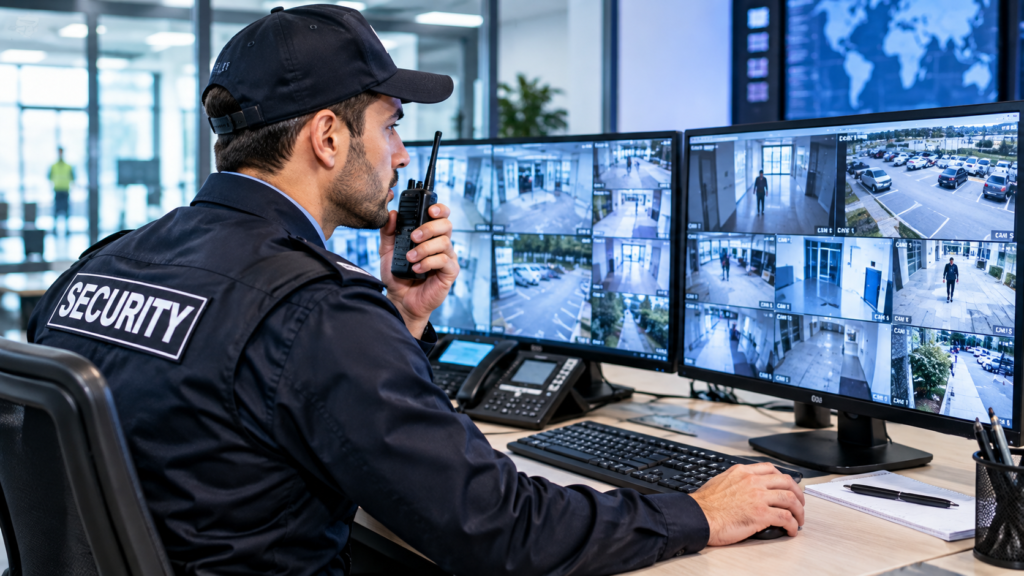
Typical duties can include monitoring entrances and the exits, checking identification, controlling visitor access, observing CCTV new systems, conducting patrols, protecting property, and a writing incident reports, responding to alarms, and communicating with a supervisors.
Some guards work in the relatively low-risk environments such as office buildings or residential complexes. Others may work at warehouses, industrial sites, construction projects, big hotels, transportation facilities, or very large events.
A job description might include all responsibilities such as:
Access Control
Guards may check employees, visitors, contractors, deliveries, or identification all documents before allowing the entry.
Site Patrols
Patrol officers may walk or drive around a designated area to the identify unusual activity, safety concerns, property damage, or a unauthorized access.
CCTV Monitoring
Some positions require monitoring surveillance new systems and reporting suspicious activity to supervisors or a emergency services when appropriate.
Incident Reporting
Professional security officers are often expected to the document incidents accurately. Written communication can therefore be an most important part of the job.
Emergency Response
Depending on training and the local law, guards may respond to alarms, accidents, or fires, medical emergencies, or a other incidents while contacting the appropriate emergency services.
Requirements for Security Guard Jobs With a Visa Sponsorship 2026
Requirements vary widely. A vacancy in one country may have completely different requirements from a similar job elsewhere.
Common requirements can include:
- Minimum legal working age
- Valid passport
- Relevant work experience
- Clean or acceptable criminal-record history
- Security training
- Local security license
- Physical ability to perform job duties
- Good communication skills
- Language proficiency
- Ability to work shifts
- References from previous employers
- Background verification
Some employers may prefer applicants who have previous good experience in security, military service, law enforcement, hospitality, and customer service, or other jobs involving responsibility and public interaction.
However, previous experience does not automatically make someone eligible for a sponsored position. Immigration eligibility and the occupational licensing remain separate issues.
Security Licensing and Training
One of the most important issues international applicants should investigate is local security licensing.
Security is a regulated profession in the many jurisdictions. A person may need to complete approved training, or pass background checks, obtain a license, or satisfy other regulatory requirements before working as a security officer.
This means an overseas applicant may receive an employment offer but still very need to complete local training or licensing procedures before the beginning certain duties.
Training can cover many areas such as:
- Security responsibilities
- Communication
- Incident reporting
- Emergency procedures
- Conflict management
- Legal responsibilities
- Access control
- Patrol procedures
- Workplace safety
- First aid, where required
Specialized positions can have additional some requirements.
For example, jobs involving certain equipment, transportation facilities, very high-security environments, or specialized responsibilities may a require additional certifications.
Read Also : Visa Sponsorship Jobs in Finland 2026: A Guide for Foreign Workers
Experience and some Skills Employers May Look For
Experience can strengthen a security guard application, although requirements differ between the employers.
Useful experience may include:
Security experience: Previous work as a security officer, security guard, and patrol officer, or similar very professional can demonstrate familiarity with the occupation.
Military full experience: Some employers value transferable many skills developed through military service, although applicants should still check whether local licensing or the certification is required.
Customer-service some skills: Security guards frequently interact with employees, visitors, or customers, contractors, and members of the public.
Communication: Guards very need to communicate incidents clearly and very professionally.
Observation: Security work requires attention to surroundings, unusual behavior,and access points, equipment, and site conditions.
Reliability: Shift-based security work often requires the punctuality and consistent attendance.
Report writing: Accurate incident documentation is an very important part of many security roles.
Applicants should describe these some skills honestly on their CV rather than adding qualifications or full experience they do not have.
Step-by-Step Guide to the Applying
Choose a Destination
Start by identifying countries where your some skills, experience, language abilities, and a immigration circumstances may fit available opportunities.
Research official government all information before applying.
Check Licensing all Requirements
Determine whether security guards very need a local license or certification.
This step can prevent wasted applications because the some jobs may require credentials that cannot be obtained until you are a legally present in the country.
Prepare Your profesional CV
Create a professional CV that the clearly lists:
- Security experience
- Previous employers
- Employment dates
- Relevant training
- Certifications
- Languages
- Customer-service experience
- Technical skills
- References, where appropriate
Do not exaggerate military, security, law-enforcement, or supervisory experience.
Search for Employers
Prioritize company career pages and established recruitment platforms.
Look carefully at the employer’s identity, physical presence, contact information, and job description.
Complete Interviews
Interviews may cover previous security experience, handling difficult situations, communication, reliability, shift availability, and knowledge of security procedures.
Verify the Offer
Before paying money or providing sensitive information, independently verify the employer and job offer.
Documents You May Need
The required documents vary by country and employer, but applicants may be asked for:
- Passport
- CV or résumé
- Employment references
- Security certificates
- Educational documents
- Professional licenses
- Police or criminal-record documentation
- Passport photographs
- Employment contract
- Job offer letter
- Work-permit documentation
- Visa application forms
- Medical documentation where required
- Biometric information where required
Keep digital and physical copies of most important documents.
If a recruiter asks for original documents, first establish why they are the required and whether the request is legitimate.
Salary and the Employment Benefits 2026
Security guard salaries vary considerably according to a country, city, employer, experience, licensing level, or working hours, and type of security assignment.
A higher salary advertisement should not automatically be interpreted as a better or more legitimate opportunity. Some advertised figures may the include overtime, night-shift allowances, bonuses, or the other payments rather than the basic wage.
Benefits can also differ.
A security position might offer:
- Basic salary
- Overtime pay
- Night-shift allowance
- Paid vacation
- Health-related benefits
- Pension contributions
- Transportation assistance
- Uniforms
- Training
- Accommodation, in some cases
- Meals, in some cases
Never assume that the accommodation, flights, meals, or a visa costs are included unless the written employment terms clearly state this.
Accommodation and some Other Benefits
Some international recruitment programs may advertise accommodation or a housing assistance. This can be particularly relevant for the workers moving abroad for the first time.
However, “accommodation provided” can mean very different things. It might refer to shared housing, employer-provided rooms, a housing allowance, temporary accommodation, or a assistance finding accommodation.
Before accepting an full offer, ask for written full details about:
- Whether accommodation is the free or deducted from wages
- Whether the room is shared
- Location
- Utilities
- Transportation
- Duration of accommodation
- Rules for employer-provided new housing
The same principle applies to meals, transportation, or flights, uniforms, and other benefits.
Frequently Asked some Questions
Can foreigners get security guard jobs with the visa sponsorship?
It depends on the country, immigration program, employer, and a security licensing rules. Some employers may recruit internationally, and while others require applicants to already have legal work authorization.
Do security guards very need a license?
In many jurisdictions, security work is the regulated and requires a local license or approved training. The exact requirements depend on the location and a type of security work.
Can I apply without previous security full experience?
Some entry-level positions may accept candidates without the extensive security experience, while others require previous work experience. International applicants should also consider whether immigration and licensing all rules impose additional requirements.
Does visa sponsorship guarantee the visa approval?
No. An employer’s sponsorship or full support does not necessarily guarantee that an immigration application will be approved. The applicant and employer must satisfy the applicable legal all requirements.
Are accommodation and the flights included with sponsored security jobs?
Not necessarily. Some employers may full offer accommodation, transportation, flights, or allowances, and while others do not. These benefits should be confirmed in the written employment terms.