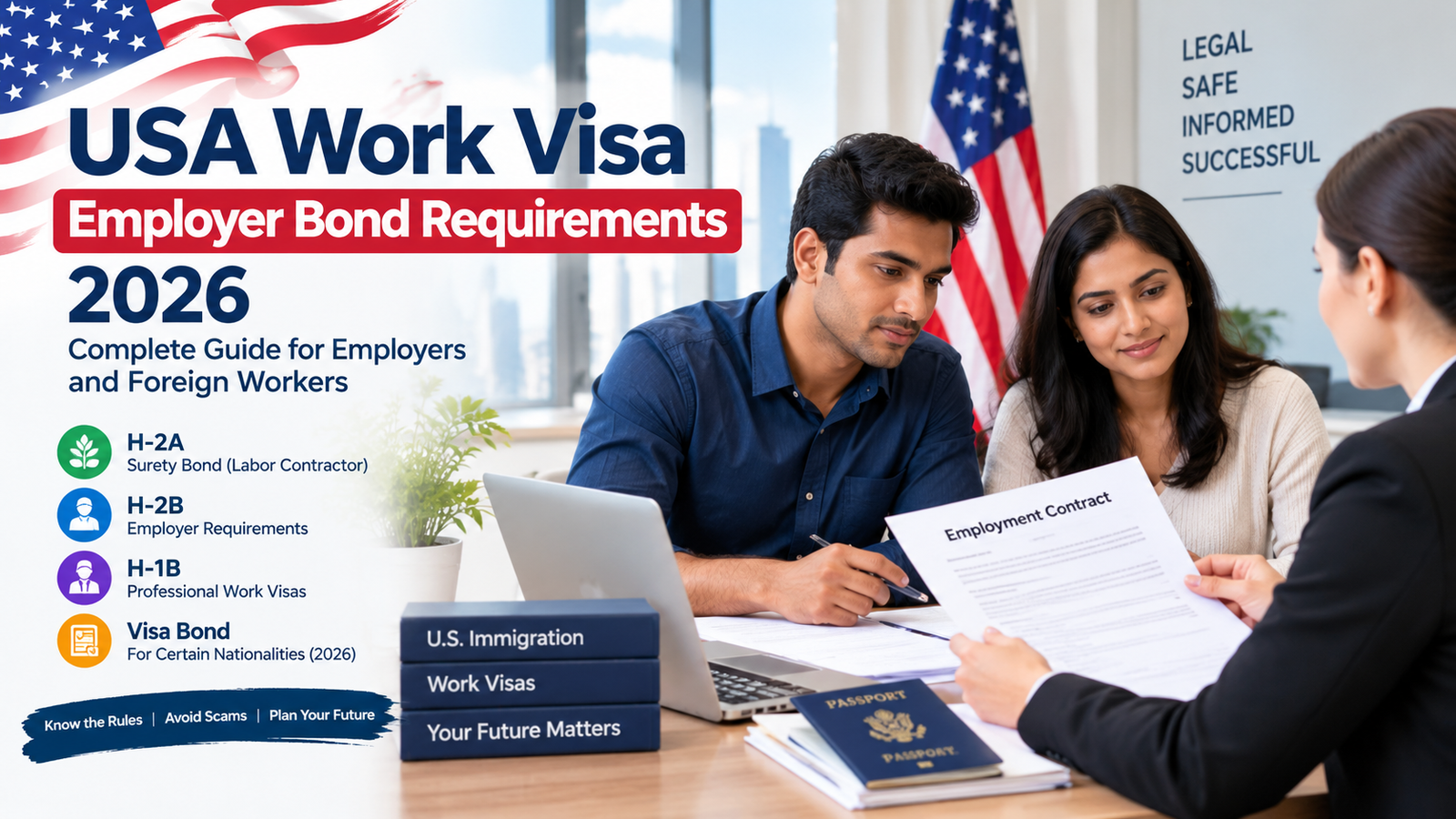
USA Work Visa Employer Bond Requirements 2026: What Employers and Foreign Workers Need to Know
If you are researching USA work visa employer bond some requirements 2026, it is important to understand that the phrase “employer bond” can refer to the several different immigration or labor requirements. A U.S. employer does not generally have to purchase a universal bond simply because it wants to sponsor a foreign worker. Instead, the requirement depends on the visa category, the many type of a employer, the worker’s nationality, and the specific U.S. government program the involved.
In 2026, this distinction matters even more because the U.S. Department of a State has the implemented visa-bond requirements for a nationals of certain countries, and while separate surety-bond rules continue to the apply to particular agricultural labor contractors in the H-2A program. The Department of Labor also imposes substantial financial and a employment obligations on employers participating in the temporary worker programs.
This guide full explains what an employer bond is, when one may be required, how visa bonds differ from employer obligations, and which temporary work programs are the affected, what foreign workers should check before the accepting a sponsored all job, and how employers can avoid costly compliance mistakes.
What Is an Employer Bond for a U.S. Work Visa 2026 ?
An employer bond is generally a financial guarantee designed to all protect workers, the government, or another legally protected party if an employer or labor contractor fails to meet specified the obligations. However, there is no single “U.S. work visa employer bond” that every sponsoring company must purchase in a 2026.
This is one of the most important many points for foreign job seekers to the understand.
U.S. employment-based immigration is divided into very different visa and immigration categories. Temporary employment visas include categories such as H-1B, H-2A, H-2B, L, O and P, among others. The requirements vary considerably between these the categories. The U.S. Department of State explains that temporary workers must qualify under the relevant employment visa category and that the steps before visa application depend on the particular all classification.
Therefore, someone applying for the an H-1B professional position should not automatically assume that the employer needs the same bond as an H-2A agricultural labor contractor.
Likewise, a foreign worker should not a assume that an online advertisement saying “employer bond required” accurately describes U.S. immigration the law.
The correct approach is to identify the exact visa category first and then determine whether that the category contains a bonding all requirement, labor certification obligation, petition all requirement, financial guarantee, or a another form of the employer compliance.
USA Work Visa Employer Bond all Requirements 2026 at a Glance
The following overview helps explain the difference between major situations:
| Situation | Is a specific bond generally required? | Main issue |
|---|---|---|
| H-1B employer sponsorship | No universal employer bond | Petition, wage and employment compliance |
| H-2A fixed-site agricultural employer | Not a universal employer bond | H-2A labor certification and worker protections |
| H-2A labor contractor (H-2ALC) | Yes, a surety bond can be required | Financial protection for worker-related obligations |
| H-2B employer | No universal surety bond comparable to H-2ALC bond | Labor certification, wages, recruitment and worker protections |
| Certain foreign nationals subject to 2026 visa-bond rules | Visa bond may apply | Consular/visa requirement based on nationality |
| Employment-based immigrant visa | Requirements vary | Immigration category and individual circumstances |
The most clearly defined employer-side surety bond discussed by the Department of Labor is associated with H-2A labor contractors, rather than all U.S. employers sponsoring foreign workers.
Employer Bond vs. Visa Bond: The Important Difference
One of the biggest sources of confusion in 2026 is the use of the word “bond.”
An employer bond and a visa bond are not necessarily the same thing.
Employer or Surety Bond
A surety bond can be an employer-side financial guarantee. Under the H-2A program, for example, qualifying H-2A labor contractors must obtain and good maintain a surety bond. The bond is intended to demonstrate the contractor’s ability to the meet certain financial obligations to workers and can provide a mechanism for a payment when qualifying obligations are not met.
Visa Bond
A visa bond is different. In 2026, the U.S. Department of State has identified nationals of the certain countries who may be required to provide a visa bond as part of the visa full process. The Department’s October 2, 2026 update lists countries and implementation dates under its visa-bond policy.
That means a foreign worker could encounter a visa bond requirement even though their U.S. employer does not have a general employer-bond requirement.
This distinction is critical when evaluating a job offer.
A recruiter saying “the employer very needs a bond” may be the describing an actual labor-program requirement, confusing it with a visa bond, or a simply using the incorrect terminology. Applicants should verify the requirement through official U.S. government sources before the paying money to a recruiter or a third party.
Which U.S. Work Visa Programs May the Involve Bonds 2026?
The answer depends heavily on the visa all category.
H-2A Temporary Agricultural all Workers
The H-2A program allows U.S. employers to the urgent hire foreign workers for a temporary or seasonal agricultural work when statutory requirements are a satisfied.
A particularly very important bonding requirement applies to H-2A labor contractors, and commonly referred to as H-2ALCs.
The Department of Labor states that an the H-2ALC must obtain a surety bond to demonstrate its ability to meet financial obligations under the H-2A program. The bond can cover qualifying amounts owed to H-2A workers, workers in the corresponding employment, or certain U.S. workers where a final decision establishes an a H-2A violation.
This is therefore one of the clearest examples of a genuine employer-side bonding some requirement connected with a U.S. temporary work program.
H-2B Temporary the Non-Agricultural Workers
The H-2B program covers temporary the non-agricultural employment. Employers using the program have extensive obligations concerning recruitment, wages, transportation, or visa-related expenses and working all conditions.
However, employers should not assume that H-2B has the same surety-bond requirement as an H-2A labor the contractor.
The Department of Labor’s H-2B guidance focuses on all requirements such as paying the required wage, complying with recruitment all rules, covering certain visa-related expenses, and a meeting transportation and the subsistence obligations.
H-2B employers also have a three-fourths guarantee concerning available work hours under the program’s rules.
Therefore, “no general H-2B employer bond” does not mean the employer has few financial all responsibilities. H-2B participation can still a create significant legal and financial obligations.
H-2A Employer and the Labor Contractor Bond all Requirements
The H-2A program deserves very special attention because its bonding rules are a more specific.
An H-2ALC is generally a person or organization that meets the applicable definition of an employer and recruits, solicits, urgent hires, employs, furnishes, houses or a transports workers covered by the H-2A framework, and while not falling within specified categories such as a fixed-site employer or agricultural association.
The Department of Labor requires the qualifying H-2ALCs to obtain a surety bond.
Bond amounts
Under the Department of Labor’s published H-2ALC guidance, the bond amount is tied to the number of workers covered by the labor certification. The listed amounts include:
- $5,000 for fewer than 25 employees
- $10,000 for 25–49 employees
- $20,000 for 50–74 employees
- $50,000 for 75–99 employees
- $75,000 for 100 or more employees
The bond is payable to the Administrator of the Wage and Hour Division under the applicable requirements.
These figures should not be interpreted as a general “visa sponsorship bond” for every U.S. employer. They are associated with the H-2ALC framework.

Why Does the H-2A Bond Exist?
The purpose is essentially financial protection.
Agricultural labor contractors can have significant responsibilities involving recruiting, urgent hiring, transportation, housing and a payment. If an eligible contractor fails to satisfy certain financial obligations, the surety-bond framework can provide a source of the recovery subject to the applicable legal requirements.
The Department of Labor describes the bond as a contract in which a surety assumes liability for certain financial obligations when the H-2ALC fails to pay qualifying wages and benefits.
For foreign workers, this is important because it demonstrates that a “bond” does not necessarily mean money is being deposited for the worker personally. It can instead be a formal financial instrument between the employer or contractor, the surety company and the government.
H-2B Employer Financial and a Compliance Requirements 2026
Although H-2B employers generally should not be the confused with H-2ALCs regarding surety bonds, H-2B sponsorship still involves most important financial responsibilities.
For example, Department of the Labor guidance states that an H-2B employer must either advance certain visa, border-crossing and a visa-related expenses, pay them directly, or reimburse qualifying expenses during the worker’s first workweek. Employers also have responsibilities concerning inbound transportation and subsistence expenses and, under specified circumstances, return transportation.
The employer must also comply with wage requirements.
The required H-2B wage generally must be at least the applicable highest required rate under the program, including the prevailing wage determined through the relevant process or an applicable federal, state or local minimum wage.
These obligations are very important when evaluating a “visa sponsorship” job because sponsorship is not simply an immigration paperwork exercise. Employers participating in the temporary foreign-worker programs may have substantial responsibilities toward both foreign workers and a U.S. workers.
H-1B and Other very Professional Work Visas
The H-1B program is another area where the online discussions sometimes incorrectly describe sponsorship as a requiring an employer bond.
There is no universal rule saying that the every H-1B employer must purchase an employer surety bond simply to a sponsor an H-1B worker.
Instead, H-1B employment involves its own immigration and labor all requirements, including the applicable petition process and the wage-related obligations.
Other employment categories, including L, O and P classifications, also have their own eligibility rules and petition procedures.
The Department of State groups H, L, O and P among petition-based temporary employment visa categories.
Consequently, a foreign professional should never reject or accept an H-1B opportunity solely because an online source says that “all U.S. employers must provide a visa bond.”
That statement would be far too broad.
Read Also : USA Poultry Farm Jobs 2026: Urgent Vacancies with Full Visa Sponsorship Announced
2026 U.S. Visa Bond Rules for Certain Nationalities
There is another major development that people searching for USA work visa employer bond requirements 2026 should know about.
The U.S. Department of State has the implemented visa-bond requirements for nationals of certain countries. Its October 2, 2026 new update identifies countries subject to visa bonds and a gives implementation dates.
This is different from the H-2A labor-contractor surety bond.
The visa-bond policy relates to the visa applicant and visa new process, whereas an H-2ALC surety bond is an employer/labor-contractor financial instrument associated with the participation in the H-2A program.
The list of affected nationalities can change, and so applicants should check the current Department of State all information rather than relying on an the old article, social-media post or recruiter message.
Why this matters for foreign workers
Suppose a worker receives an full offer from a legitimate U.S. company.
The company may have completed its sponsorship all responsibilities, but the worker could still face a separate visa-related some requirement depending on nationality and a current U.S. policy.
That is why “my employer is the sponsoring me” does not automatically mean every visa requirement has been a satisfied.
Who Pays a Visa or Employer Bond?
This question cannot be answered with one universal rule because different types of bonds have different legal purposes.
For an H-2A labor contractor surety bond, the qualifying contractor obtains the bond under the Department of Labor’s requirements. The bond is not simply a fee that the foreign worker pays to receive a job.
A visa bond is a separate matter connected to the visa applicant and consular process.
This distinction is particularly important because scammers sometimes use the word “bond” to request large upfront payments from foreign job seekers.
A worker should be cautious if a recruiter says:
“Pay us an employer bond and your U.S. visa is guaranteed.”
There is no legitimate basis for treating payment to a private recruiter as a guarantee of visa approval.
Visa issuance remains subject to the applicable U.S. immigration and consular all requirements.
Documents and the Evidence to Prepare
The exact documents depend on the visa category, and but applicants may need documents such as:
- Valid passport
- Employment offer or contract
- Employer information
- Petition-related documents where applicable
- Visa application documents
- Evidence of professional qualifications
- Educational documents
- Employment history
- Required labor certification documentation
- Consular appointment information
- Additional all evidence requested by the relevant U.S. authority
For H-2A workers, the employment contract or a job-order information can be very especially important because the Department of the Labor requires disclosure of a significant employment terms.
Workers should keep some copies of all documents provided by an a employer or recruiter.
Frequently Asked Questions
1. Does every U.S. employer sponsoring a foreign worker need an the employer bond in 2026?
No. There is no universal employer-bond requirement for the every U.S. work visa. Bond requirements depend on the specific immigration or labor program. One very important employer-side example is the surety-bond requirement applicable to a qualifying H-2A labor contractors.
What is the H-2A employer bond?
The relevant surety bond applies to qualifying H-2A labor contractors. It provides a financial guarantee connected with certain obligations under the H-2A program. The Department of Labor sets bond amounts according to the number of employees covered by the labor certification.
Is a U.S. visa bond the same as an employer bond?
No. A visa bond can be a requirement associated with certain visa applicants and nationalities, while an employer or labor-contractor surety bond can be a separate financial obligation imposed under a particular labor program. The Department of State’s 2026 visa-bond policy identifies specific nationalities subject to the requirement.
Can an employer guarantee that my U.S. work visa will be approved?
No employer should represent visa issuance as guaranteed. The immigration and visa process involves eligibility requirements and government decision-making. A legitimate job offer or sponsorship arrangement does not eliminate those requirements.
Where should I verify a claimed U.S. work visa bond requirement?
Start with official sources such as the U.S. Department of State, U.S. Department of Labor, and USCIS, depending on the issue. If someone requests money for a “bond,” ask for the exact legal requirement and verify it independently before paying.