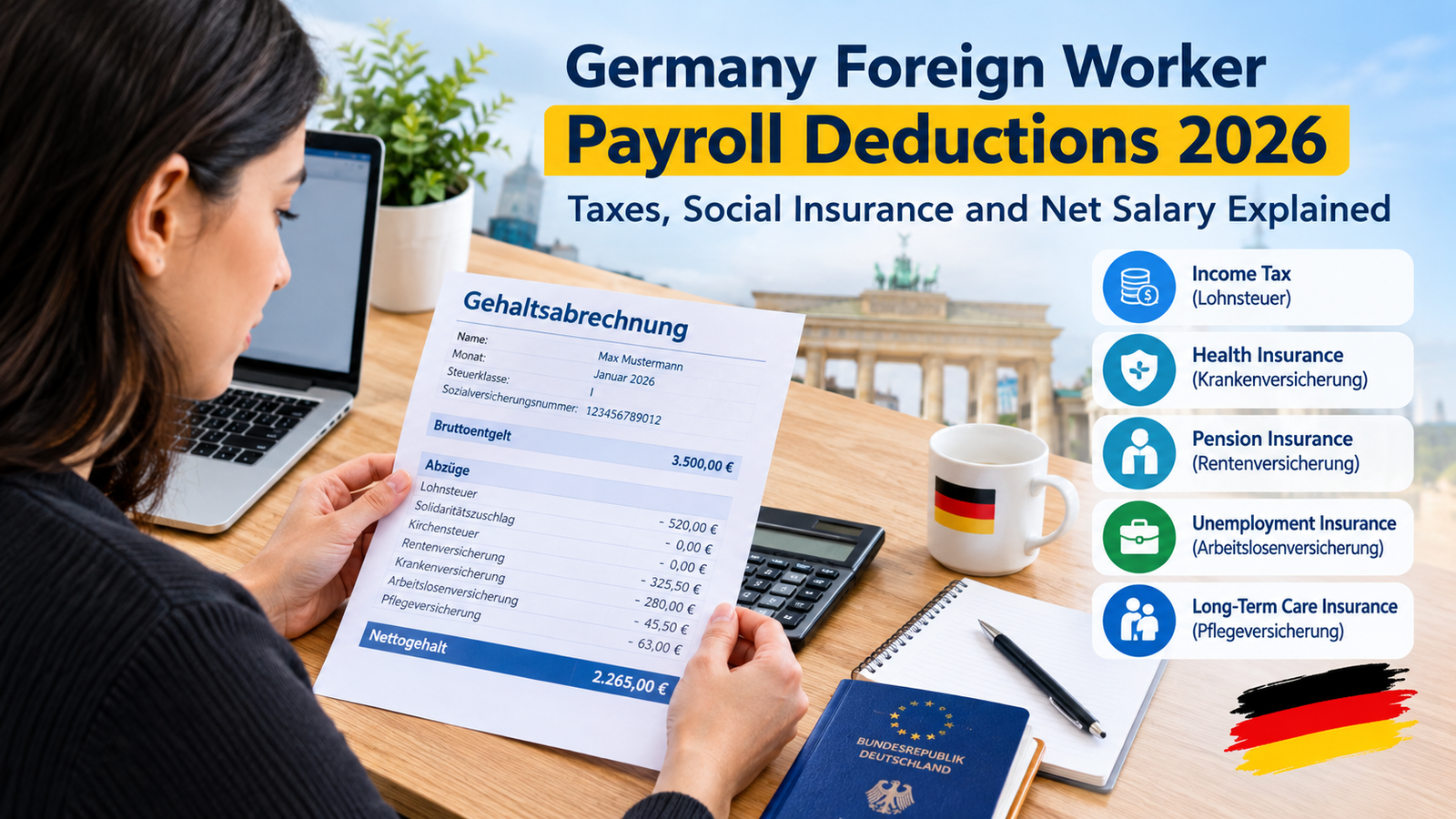
Germany Foreign Worker Payroll Deductions 2026
Starting a job in Germany can be an the exciting opportunity for foreign workers, and but understanding a German payslip is often much harder than understanding the employment contract. A worker may agree to a gross monthly salary and then discover that the amount transferred to their bank account is a significantly lower because of income tax, pension insurance, health insurance, unemployment insurance, very long-term care insurance and, in some cases, church tax or the solidarity surcharge.
Germany Foreign Worker Payroll Deductions 2026 are generally based on the same payroll and social-insurance framework that applies to the other employees, although a worker’s residence status, tax liability, or insurance arrangement, family situation and employment circumstances can affect the final calculation. Germany’s 2026 tax and contribution some rules also include updated thresholds and allowances.
This guide explains the major deductions that foreign employees should understand in a 2026. It covers German wage tax, tax classes, statutory social insurance, and contribution ceilings, health-insurance contributions, pension deductions, unemployment insurance, long-term care insurance and other possible deductions. It also full explains how to read a payslip and what workers should check before the assuming that an employer has made an error.
Germany Payroll Deductions 2026 Overview
Germany operates a payroll system in the which employers normally calculate and withhold various taxes and a employee social-insurance contributions before paying the employee’s net salary. This means workers generally do not need to calculate and transfer their regular wage tax and statutory social-insurance contributions themselves every month.
For foreign workers, the most important distinction is between gross salary and net salary. Gross salary is the contractual amount before employee deductions. Net salary is the amount that remains after the applicable deductions have been taken from a payroll.
In 2026, Germany’s basic tax-free allowance, known as the Grundfreibetrag, is the €12,348 for income tax purposes. The income-tax tariff was also adjusted for the 2026. However, the actual wage-tax deduction from an individual payslip depends on several factors, including salary, tax class, allowances, insurance contributions, marital status and other personal circumstances.
Social insurance is another major component of payroll deductions. For employees covered by Germany’s statutory system, contributions can include pension insurance, health insurance, unemployment insurance and long-term care insurance.
A foreign worker should therefore avoid judging a job offer solely by its gross salary. Understanding expected deductions provides a much clearer picture of the income that may actually reach the employee’s bank account.
Key Highlights for Foreign Workers in 2026
Several figures are particularly important when reviewing German payroll deductions in 2026:
- The general statutory pension insurance contribution rate is 18.6%.
- The employee normally pays half of the pension contribution, or 9.3%.
- Statutory unemployment insurance is 2.6%, normally divided equally between employer and employee.
- Statutory health insurance has a general contribution rate of 14.6%, with the employee normally paying half, plus half of the applicable additional contribution.
- The average additional statutory health-insurance contribution for 2026 is 2.9%, although the actual additional rate depends on the health-insurance fund.
- Statutory long-term care insurance is generally 3.6%, with special rules for employees without children and parents with multiple children.
- The 2026 contribution assessment ceiling for pension and unemployment insurance is €101,400 per year, or €8,450 per month.
- The health and very long-term-care contribution assessment ceiling is the €69,750 per year, or €5,812.50 per month.
- The general statutory good health-insurance compulsory-insurance threshold is €77,400 per year, or €6,450 per month.
These figures are useful for understanding payroll, and but they should not be treated as a universal percentage that can the simply be subtracted from every salary. Different deductions have different calculation bases and ceilings.
Gross Salary vs. Net Salary in a Germany 2026
A German employment contract normally specifies a Bruttogehalt, meaning gross the salary. This is not the amount the employee receives in their bank account.
For example, someone might receive a contract offering €4,000 gross per month. The employee’s net salary will be lower because wage tax and employee social-insurance contributions may be withheld.
A simplified payroll structure looks like this:
Gross salary
minus wage tax
minus solidarity surcharge, if applicable
minus church tax, if applicable
minus employee pension insurance
minus employee health insurance
minus employee unemployment insurance
minus employee long-term-care insurance
equals net salary
The actual calculation is more complicated because tax deductions and social-insurance contributions do not all use exactly the same calculation rules.
Foreign workers should therefore be careful with online salary calculators. A calculator can provide an estimate, but the final payroll amount depends on the worker’s personal circumstances and the payroll information available to the employer.
German Income Tax and Wage Tax
One of the most important Germany foreign worker payroll deductions in 2026 is Lohnsteuer, or wage tax.
Wage tax is essentially the income tax withheld from employment income by the employer. The employer calculates the withholding based on the employee’s taxable wage and applicable electronic tax characteristics.
The calculation does not a simply apply one flat percentage to the entire salary. Germany uses a progressive income-tax new system, meaning the effective tax burden changes as a taxable income increases.
For 2026, the basic tax-free allowance is the €12,348. This allowance reflects the principle that the minimum amount needed for basic living expenses should not be subject to income tax.
The wage-tax calculation also considers various allowances and standardized deductions. Consequently, two workers with the same gross salary can sometimes have different net pay.
Foreign employees should also understand the difference between tax withholding during the year and their final annual tax liability. Payroll withholding is designed to collect tax during the year. A worker’s final tax position can be established through an income-tax assessment or tax return where applicable.
German Tax Classes Explained
Tax class, or Steuerklasse, is another important factor in German payroll.
Germany has several tax classes, and the appropriate class depends on circumstances such as marital status and whether an employee has more than one employment relationship.
Tax Class I
Tax Class I generally applies to single employees and certain other taxpayers who do not qualify for another class.
Tax Class II
Tax Class II is associated with eligible single parents who qualify for the relevant relief for single parents.
Tax Classes III and V
These classes can apply to married couples under specific conditions. Typically, one spouse may be assigned Tax Class III while the other is assigned Tax Class V.
Tax Class IV
Tax Class IV generally applies to married couples who meet the relevant requirements and do not choose the III/V combination.
Tax Class VI
Tax Class VI generally applies to employment income from a second or additional employment relationship.
For foreign workers, the important point is that tax class affects payroll withholding, but it should not automatically be interpreted as meaning that a worker ultimately owes more or less tax over the entire year. The final annual tax position can depend on the couple’s or individual’s complete circumstances.
Social Insurance Contributions in Germany 2026
Social insurance is one of the largest components of employee payroll deductions in Germany.
For many employees, the system includes four major areas:
- Pension insurance
- Health insurance
- Unemployment insurance
- Long-term care insurance
These systems provide social protection covering retirement, healthcare, unemployment and long-term care needs.
In many cases, employer and employee share the statutory contributions. This is important because the employee’s payslip generally shows only the employee’s portion as a deduction from gross salary, while the employer separately pays its own share.
The contribution assessment ceilings also mean that contributions do not continue indefinitely as a percentage of every euro earned. Once the relevant ceiling has been reached, income above the ceiling is generally not subject to that particular contribution.
Health Insurance Deductions for Foreign Workers
Health insurance is mandatory for many employees in Germany, and the applicable arrangement depends on the employee’s circumstances.
For statutory health insurance, the general contribution rate in 2026 is 14.6%. This is normally shared between employer and employee.
In addition, statutory health-insurance funds charge an additional contribution. The average additional contribution for 2026 is 2.9%, but individual funds can have different additional rates. The additional contribution is generally shared between employer and employee for employees covered by the statutory system.
The contribution assessment ceiling for statutory health insurance is €5,812.50 per month in 2026.
Foreign workers should therefore check which health-insurance system applies to them and which health fund they are enrolled in. Employees above the statutory insurance threshold may have different options, while special rules can apply to certain groups.
Private health insurance is also possible for eligible workers, but private insurance should not be treated as simply another payroll deduction identical to statutory insurance. Premiums and employer contributions can work differently.
Pension Insurance in Germany
German statutory pension insurance is another major payroll deduction.
The general pension-insurance contribution rate in 2026 is 18.6% of the relevant contribution base. For a standard employee relationship, the contribution is generally divided equally between employer and employee.
This means the employee’s normal share is 9.3% of the contribution-assessable income, subject to the applicable contribution ceiling.
The 2026 pension and unemployment insurance contribution assessment ceiling is €8,450 per month, or €101,400 per year.
Pension contributions are not simply money disappearing from a worker’s salary. They finance Germany’s statutory pension new system and can contribute toward future pension entitlements when the employee satisfies the relevant legal many requirements.
Foreign workers should keep records of their German employment and a social-insurance history, especially if they expect to work in the Germany for several years or move between countries during their career.
Unemployment Insurance
Unemployment insurance is another standard social-insurance contribution for many employees.
The statutory unemployment-insurance contribution rate in the 2026 is 2.6%. It is generally shared equally between employer and a employee, meaning the standard employee portion is the 1.3% of the relevant contribution base.
The same €8,450 monthly contribution assessment ceiling applies to pension and unemployment insurance in 2026.
Eligibility for unemployment benefits is not determined simply by having deductions on a payslip. Benefit eligibility depends on the applicable legal requirements, insurance history and employment circumstances.
For foreign workers, residence status and other legal conditions can also matter when assessing access to particular benefits.
Long-Term Care Insurance
Long-term care insurance, known as Pflegeversicherung, is another component of German social insurance.
The standard contribution rate is 3.6% in 2026. Employer and employee generally share the basic contribution, although the employee may pay an additional surcharge if they are childless and meet the relevant age conditions.
Employees with multiple children can qualify for contribution reductions under the applicable rules.
Saxony also has different contribution-sharing rules compared with most other German federal states.
The long-term-care contribution uses the same €5,812.50 monthly contribution assessment ceiling as statutory health insurance in 2026.
This is an area where a foreign worker’s family circumstances can make a direct difference to the payroll amount. Employees should make sure their employer has the correct information regarding children where documentation is required.
Solidarity Surcharge and Church Tax
Not every employee pays every possible payroll deduction.
The Solidaritätszuschlag, or solidarity surcharge, is an additional tax that applies only in circumstances where the relevant legal conditions are met. Many ordinary employees do not pay it.
Church tax is also not universal. It can apply to members of certain recognized religious communities who are subject to church tax under the applicable rules.
The amount and treatment of church tax can depend on the federal state and the employee’s circumstances.
Foreign workers should not assume that church tax will automatically appear on every German payslip. If it appears unexpectedly, the employee should review their registered religious affiliation and tax information.
Contribution Assessment Ceilings in 2026
Contribution ceilings are particularly important for higher-income foreign workers.
In 2026, the ceiling for pension and the unemployment insurance is:
€8,450 per month / €101,400 per year
For statutory health and very long-term care insurance, the ceiling is:
€5,812.50 per month / €69,750 per year
This means that salary above these limits is the generally not included when calculating the respective statutory social-insurance contributions.
The existence of different ceilings explains why payroll calculations become more complicated as salary increases. A worker earning €4,000 per month and someone earning €10,000 per month cannot simply apply the same percentage to their entire gross salaries for every insurance category.
Example of a German Payroll Calculation
Consider a hypothetical foreign employee earning €4,000 gross per month in 2026.
This example is intended only to demonstrate the structure of payroll deductions. It is not a personalized net-salary calculation because the exact wage tax depends on tax class, personal circumstances, insurance arrangements and other information.
For pension insurance, the employee’s standard share would be approximately 9.3% of the relevant gross pay.
For unemployment insurance, the standard employee share would be approximately 1.3%.
For statutory health insurance, the employee generally pays half of the 14.6% basic contribution, plus half of the applicable additional contribution charged by the employee’s health fund.
Long-term care insurance is also deducted according to the applicable employee rate, which can vary depending on children, age and location.
Wage tax is then calculated using the employee’s applicable tax characteristics and the 2026 tax rules.
The resulting amount is the employee’s net pay.
This example demonstrates why it is misleading to say that every foreign worker in Germany loses a fixed percentage of their gross salary. The actual result is individual.
Step-by-Step Guide to Reading a German Payslip
Step 1: Find the Gross Salary
Look for terms such as Brutto, Bruttoverdienst or Gesamtbrutto.
This is the starting point for understanding the calculation.
Step 2: Check Wage Tax
Look for Lohnsteuer. Compare the tax class and other tax information shown on the payslip with your circumstances.
Step 3: Check Social Insurance
Review deductions for:
- Krankenversicherung
- Rentenversicherung
- Arbeitslosenversicherung
- Pflegeversicherung
These correspond to health, pension, unemployment and long-term care insurance.
Step 4: Look for Additional Deductions
Depending on the worker, the payslip could contain church tax, solidarity surcharge, pension-plan deductions, wage advances, benefits in kind or other legally permitted payroll items.
What Foreign Workers Should Check
Foreign workers should review their first few payslips carefully instead of assuming that every deduction is correct simply because it appears on the document.
First, check the spelling of your name, tax identification information and other personal details. Then confirm that your gross salary matches your employment contract.
Next, check the tax class and health-insurance information. If you have children, make sure information relevant to long-term care insurance has been correctly recorded where necessary.
It is also useful to compare your payslip with the employment contract when overtime, bonuses, holiday pay or other additional compensation is involved.
If a deduction seems unusual, ask the employer’s payroll department for an explanation. For complicated tax situations, particularly those involving multiple countries, tax residency, foreign income or cross-border employment, professional tax advice can be appropriate.
Frequently Asked Questions
Do foreign workers pay the same payroll deductions as German workers?
Generally, foreign employees working as employees in Germany are subject to the applicable German payroll and social-insurance rules in the same general framework as other employees. However, individual circumstances, international agreements, residence status and insurance arrangements can affect the actual treatment.
How much tax is deducted from a foreign worker’s salary in Germany?
There is no single fixed percentage for every foreign worker. Wage tax depends on taxable income, tax class, allowances and individual circumstances. Social-insurance contributions are calculated separately under their respective rules.
What is the employee pension contribution in Germany in 2026?
The general pension contribution rate is 18.6%, normally divided equally between employer and employee. The standard employee share is therefore 9.3% of the contribution-assessable income, subject to the applicable ceiling.
What is the health-insurance contribution in Germany in 2026?
The general statutory health-insurance rate is 14.6%, with employer and employee normally sharing the basic contribution. There is also an additional contribution, with an average rate of 2.9% for 2026. The actual additional rate can vary by health-insurance fund.
Why is my German net salary lower than my gross salary?
German payroll normally includes wage tax and employee social-insurance contributions. Depending on the worker, additional deductions such as church tax or other employment-related deductions may also apply.