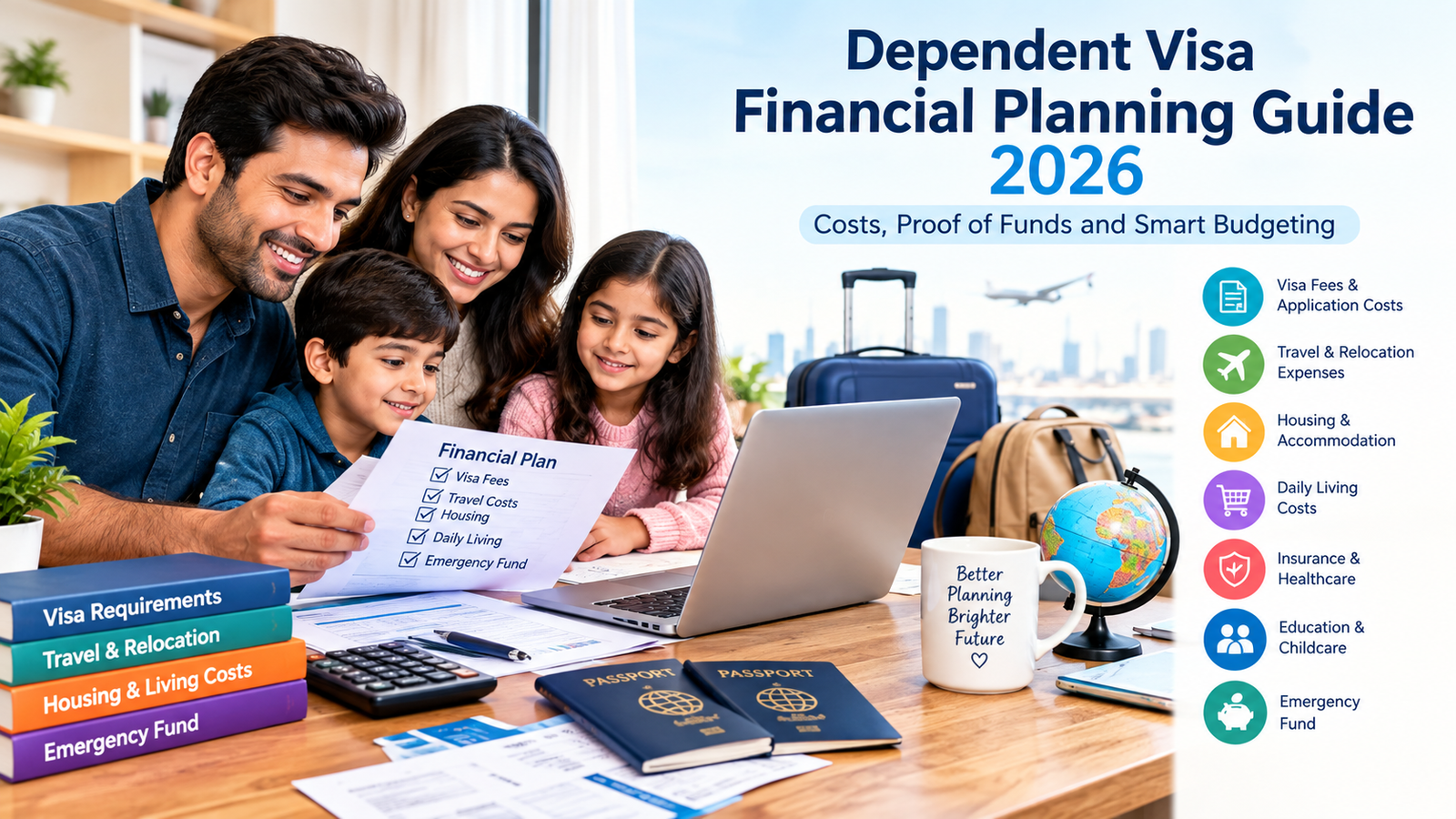
Dependent Visa Financial Planning Guide 2026: Costs, Proof of Funds and Smart Budgeting
Planning for a dependent visa in the 2026 involves much more than checking whether a sponsor earns enough money. Families moving internationally often very need to consider visa fees, proof of income or savings, accommodation, or healthcare, transportation, education, insurance, emergency funds, and the everyday cost of full supporting additional family members.
The term dependent visa financial planning can mean different things depending on the destination country and a visa category. Some immigration routes focus mainly on the sponsor’s income, while others may require savings, a formal financial undertaking, or evidence that the family can meet its the living costs. For example, the UK’s family visa some rules generally require a qualifying partner application to a demonstrate a combined income of at least £29,000, while Canada’s spouse, partner and the dependent-child sponsorship rules generally do not impose a minimum necessary income for those categories, although sponsors must still be able to the provide a basic needs.
This Dependent Visa Financial Planning full Guide 2026 explains how to build a realistic financial plan before the applying. It covers income, savings, documentation, or all application expenses, monthly living costs, emergency reserves, and a practical budgeting strategies so families can prepare based on their specific immigration route rather than the relying on a generic figure.
Dependent Visa Financial Planning: What It Means
Dependent visa financial planning is the new process of estimating and preparing the money required to bring or accompany eligible family members to the another country.
A dependent may be a spouse, partner, child, or, under the some immigration systems, another qualifying a family member. The exact definition is determined by the immigration category rather than by the general use of the word “dependent.”
Financial planning has two separate sides.
The first is immigration financial eligibility. This asks whether the applicant or sponsor meets the financial rules of the visa category. Depending on the country, this may involve salary, employment income, savings, assets, a sponsorship undertaking, or evidence of adequate maintenance.
The second is the real-life affordability. A family may technically satisfy an immigration requirement but still struggle if rent, food, transportation, or childcare, school expenses, insurance, and other costs are a not included in the household budget.
For that reason, a sensible 2026 new plan should never be based solely on the minimum amount mentioned on an the immigration website.
Key Highlights for Dependent Visa Financial Planning 2026
Before starting an all application, keep these principles in the mind:
- Immigration financial requirements vary significantly by the country and visa category.
- A minimum immigration threshold is not necessarily the same as a comfortable household budget.
- Salary should be evaluated using the type of income the immigration authority actually accepts.
- Savings can be important even when they are not formally required.
- Bank statements and other financial evidence should be consistent and genuine.
- Visa fees are only one part of the total relocation cost.
- Families should budget for a several months of the living expenses where practical.
- Children can significantly change housing, education, or childcare, food, and transportation costs.
- Financial rules can change, and so applicants should verify the latest official requirements before the submitting an application.
The most important principle is very simple: separate “meeting the visa requirement” from “being financially ready to the relocate.”
Understanding Dependent Visa Financial Requirements in 2026
There is no single worldwide dependent visa financial requirement. Each country establishes its own immigration rules, and different visa categories within the same country can have different standards.
For example, the UK’s current family visa guidance states that partners generally need to demonstrate combined income of at least £29,000 per year, subject to exceptions and route-specific rules. The UK also explains that certain forms of income and cash savings may be used to meet financial requirements depending on the circumstances.
Canada takes a different approach for many spouse, partner and dependent-child sponsorship applications. Canada’s official guidance says that, in most cases, there is no minimum necessary income requirement for sponsoring a spouse, partner or dependent child, but the sponsor must still demonstrate the ability to provide basic needs and meet other sponsorship conditions.
The United States also has a different model for many family-based immigrant cases. USCIS uses Form I-864, Affidavit of Support, to demonstrate adequate financial support. The sponsor generally needs to show income or assets meeting the applicable requirements for the household and intending immigrants.
These examples show why copying a financial figure from another country can be dangerous. A number that applies to the one immigration route may have no relevance to a another.
Income vs. Savings: Which the Matters More?
A common question is a whether applicants should focus on all salary or savings.
The answer depends on the immigration route.
Employment Income
Regular employment income is often easier to demonstrate when the rules specifically recognize employment earnings. Evidence may include payslips, tax records, or employment contracts, employer letters, and a bank statements.
However, applicants should not assume that the every type of a income automatically qualifies.
Some immigration systems distinguish between:
- employment income
- self-employment
- rental income
- pension income
- dividends
- investment income
- cash savings
- assets
The UK, for example, lists employment income, self-employment income, cash savings above a specified level, pension income, and certain non-work income among sources that may count under its family visa financial rules.
Savings
Savings can provide an important financial cushion during relocation. They may also be relevant to immigration eligibility under some routes.
Even where savings are not required, having an the emergency reserve can help cover unexpected expenses such as temporary accommodation, delayed employment, and transportation problems, medical costs, deposits, or the school-related expenses.
The key is to distinguish acceptable financial evidence from personal financial security. A bank balance may look strong, but the money may already be committed to another expense.
How to Calculate Your Dependent Visa Budget
A useful budget should have at least five categories.
1. Immigration and Application Costs
Start with expenses directly connected to the application, such as:
- visa application fees
- biometric fees where applicable
- document translation
- certified copies
- medical examinations where required
- police certificates where required
- courier charges
- professional immigration advice, if used
- travel to an application or biometric center
Not every applicant will have every expense. Create a personalized list instead of assuming a standard package.
2. Travel and Relocation
The journey itself can become a major expense for a family.
Consider:
- airline tickets
- additional baggage
- airport transportation
- temporary accommodation
- meals during travel
- local transportation after arrival
If several family members are the traveling together, multiply transportation and good accommodation costs accordingly.
3. Housing
Housing is often one of the very largest expenses after arrival.
Budget for:
- first month’s rent
- security deposit
- utility deposits, if applicable
- furniture
- household supplies
- internet installation
- transportation from the property to work or school
A family that can afford monthly rent may still need a substantial amount upfront to secure accommodation.
4. Daily Living
Estimate monthly expenses for:
- groceries
- transportation
- utilities
- mobile services
- clothing
- personal items
- childcare
- school-related costs
- insurance
- recreation
Use realistic local prices rather than converting your current spending directly into another currency.
5. Emergency Reserve
Finally, establish money that you do not intend to spend during normal monthly living.
This reserve is particularly important when one person is financially responsible for several dependents.
Step-by-Step Dependent Visa Financial Planning Guide 2026
Step 1: Identify the Exact the Visa Category
Do not start with a generic search for “dependent visa requirements.”
First identify:
- destination country
- main visa holder’s visa category
- dependent’s relationship to the main applicant
- dependent’s age
- number of dependents
- application location
- whether the dependent is applying from inside or outside the country
These details can completely change the financial requirements.
Step 2: Read the Official Financial all Rules
Once the visa category is a known, check the immigration authority’s the official website.
Look specifically for:
- minimum income
- savings requirements
- acceptable income sources
- sponsorship rules
- financial undertakings
- household-size calculations
- document requirements
- exceptions
- special rules for children
Do not rely on social media posts or old immigration articles for the final requirement.
Financial Documents for a Dependent Visa
Documentation is one of the most important parts of financial preparation.
A strong document package should be accurate, consistent and traceable.
Bank Statements
Bank statements can show the history and availability of funds. If savings are being relied upon, applicants should carefully check whether the immigration route has specific rules concerning the source, ownership, holding period, or accessibility of the money.
Payslips
Payslips can support employment income. Keep them organized chronologically.
Employer Letter
An employer letter may confirm job title, salary, employment status, start date, and other information required by the immigration route.
Tax Documents
Tax returns or official tax records can be particularly useful for self-employed applicants or people whose income is more complicated.
Sponsorship Documents
Some countries use formal sponsorship commitments. In those cases, the sponsor may have legal responsibilities beyond simply providing a bank statement.
For example, US family-based immigration can involve Form I-864, which creates a formal sponsorship obligation and requires financial information about the sponsor and household.
Country-Specific Differences You Should Know
UK
The UK family visa system uses route-specific financial requirements. For partner applications under the current rules, the general minimum income requirement is £29,000, although exceptions and different rules can apply. The UK also provides rules for using certain savings and other income sources.
Applicants should therefore avoid treating £29,000 as a general “dependent visa cost.” It is a specific financial requirement for particular family visa circumstances.
The UK government has also published a review of family visa financial requirements, demonstrating that this area of immigration policy is subject to continuing examination.
Canada
Canada’s spouse, partner and dependent-child sponsorship system is structured differently. Official guidance states that, in most cases, sponsors do not need to meet a minimum necessary income for sponsoring a spouse, partner or dependent child, while still needing to meet sponsorship requirements and provide for basic needs.
This makes it especially important to identify the exact Canadian sponsorship category before calculating finances.
United States
US family-based immigration can involve an Affidavit of Support. USCIS describes Form I-864 as a contract between the sponsor and the US government and explains that sponsors generally demonstrate sufficient income or assets according to the applicable requirements.
The household-size calculation and the financial evidence required can therefore matter significantly.
Building an Emergency Fund for Dependents
An emergency fund should be treated separately from money reserved for the visa application.
A family arriving in a new country may experience unexpected costs such as:
- delayed salary payments
- temporary housing
- higher-than-expected rent
- transportation expenses
- medical bills
- childcare
- school expenses
- replacement documents
- unexpected travel
A practical approach is to build the emergency reserve before a departure rather than expecting to save it after the arrival.
The ideal amount depends on a family size, destination, employment stability, or housing arrangements, and access to other resources. Instead of using an arbitrary universal number, calculate several months of essential expenses and then decide how much additional protection your circumstances require.
Monthly Budget Planning After Arrival
A dependent visa financial plan should continue after the visa is granted.
Create a monthly budget with categories such as:
| Expense | Monthly Estimate |
|---|---|
| Rent/Housing | $_____ |
| Utilities | $_____ |
| Groceries | $_____ |
| Transportation | $_____ |
| Healthcare/Insurance | $_____ |
| Childcare/Education | $_____ |
| Mobile/Internet | $_____ |
| Personal Expenses | $_____ |
| Emergency Savings | $_____ |
| Other | $_____ |
The currency should be changed according to the destination country.
The purpose is the not to predict every expense perfectly. Instead, it gives the family a realistic framework for identifying areas where a costs could become difficult.
Frequently Asked some Questions
1. How much money do I need for a dependent visa in the 2026?
There is no universal amount. The required financial evidence depends on the destination country, visa category, and relationship to the main applicant, household size and circumstances. Some routes use income thresholds, and while others may use savings, sponsorship undertakings or the adequate-maintenance tests.
2. Can savings replace income for a dependent visa?
Sometimes. Certain immigration routes specifically allow qualifying savings to be used instead of, or alongside, income. However, the calculation and evidence requirements vary. The UK family visa system, for example, allows certain cash savings to be considered under its financial rules.
3. Is a bank statement enough to the prove financial eligibility?
Not necessarily. Depending on the route, applicants may very need payslips, employer letters, tax records, sponsorship forms or a additional evidence. A bank balance alone does not automatically establish the eligibility.
4. Should I save extra money beyond the visa requirement?
Yes, from a personal budgeting perspective, it is sensible to plan for relocation and emergency costs separately from the formal immigration requirement. The official minimum and the amount a family actually needs to live comfortably can be very different.
5. Can dependent visa financial requirements change?
Yes. Immigration policies and application requirements can be amended. Applicants should verify the current official rules before applying rather than relying on an older article or social media post.