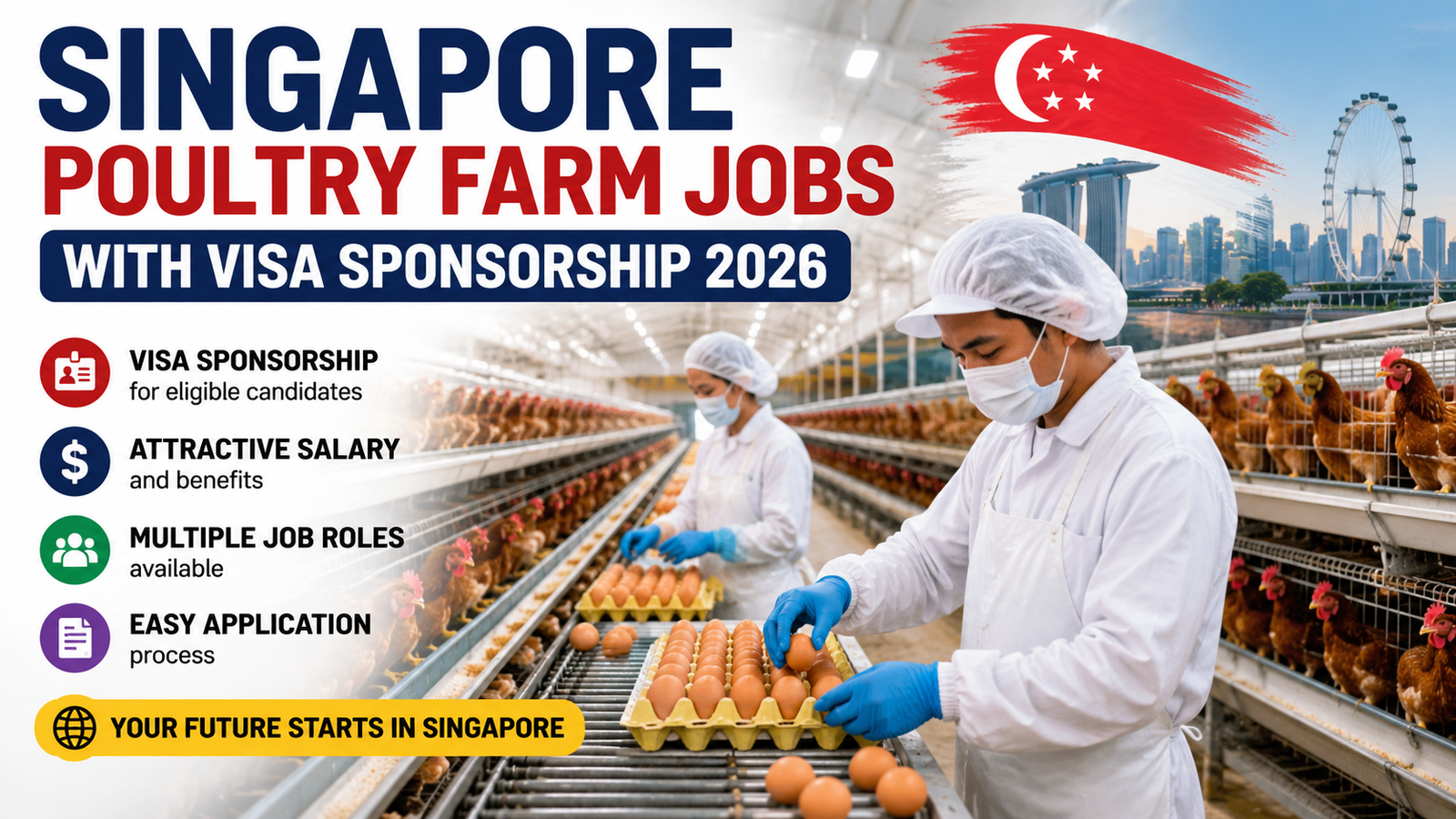
Singapore Poultry Farm Jobs With Visa Sponsorship 2026
Singapore poultry farm jobs can look attractive to the international workers because the country has a small but technologically advanced agricultural sector, including licensed egg farms in areas such as Lim Chu Kang. However, anyone searching for a Singapore poultry farm jobs with visa sponsorship in 2026 should understand an most important point before applying: Singapore’s Ministry of Manpower (MOM) does not list agriculture or the farming among the standard sectors covered by the ordinary Work Permit framework for migrant workers. The recognised sectors include construction, manufacturing, or marine shipyard, process and services.
That does not mean there are no poultry-related employment opportunities in a Singapore. Farm businesses can recruit workers for legitimate many roles, and poultry-related businesses may also operate in a food processing, production, quality control, logistics or other categories that have different employment-pass rules. Singapore’s official food agency, SFA, recognises licensed egg farms and the imposes food-safety and biosecurity requirements on the poultry operations.
This guide full explains what poultry farm work involves, typical salary all information, the current work-pass situation, qualifications, application steps, or possible related jobs, scam warnings and practical ways international applicants can search for a legitimate opportunities in 2026.
Singapore Poultry Farming Jobs: 2026 Overview 2026
Singapore has a relatively small agricultural sector compared with the many countries, and but farming remains part of the country’s food-resilience strategy. The Singapore Food Agency regulates licensed farms producing food for a human consumption, including egg farms, and requires operators to comply with the licensing and a food-safety conditions. Poultry farms must also implement appropriate biosecurity measures to reduce the risk of animal diseases affecting production.
Official SFA information identifies egg farms among Singapore’s licensed agricultural operations. Its current SG Fresh Produce information lists poultry layer or egg farms including N & N Agriculture, Chew’s Agriculture and other agricultural businesses. This means genuine poultry and egg production exists in the Singapore, although the number of farms is limited and employment opportunities can be much more specialised than the very large-scale farm-worker markets found in countries such as Australia, Canada or the New Zealand.
For job seekers, poultry work may involve animal good care, egg collection, grading, packing, cleaning, production full support, machinery operation, quality control, good maintenance or farm administration. The exact position matters because immigration eligibility is determined by the job, employer, sector and applicable work-pass rules—not simply by the fact that the workplace is called a farm.
Important Visa Sponsorship Reality in 2026
This is the most important section for international applicants. Singapore’s standard migrant Work Permit is designed for workers from approved source countries or regions employed in specified sectors. MOM currently identifies construction, manufacturing, marine shipyard, process and services as the Work Permit sectors. Agriculture is not presented as a standalone standard Work Permit sector on the current sector-specific framework.
Therefore, an online advertisement claiming “Singapore poultry farm jobs with guaranteed visa sponsorship” should be treated cautiously unless the employer clearly explains which Singapore work pass applies and why the particular position qualifies. A job advertisement alone does not create immigration eligibility.
There can nevertheless be poultry-related positions outside straightforward farm-worker duties. For example, an egg business may have production, food-processing, quality-control, administrative, engineering or logistics roles. Singapore’s NTS Occupation List includes certain food-processing occupations under specified conditions, including a requirement for the relevant firm to hold an appropriate Singapore Food Agency food-processing establishment or slaughterhouse licence.
This distinction is crucial. A poultry farm job and a poultry-related food-processing job are not automatically the same immigration category. Applicants should verify the employer, occupation, sector classification and proposed work pass before paying any recruitment fees or making travel arrangements.
Types of Poultry and Egg Farm Jobs in Singapore
Poultry Farm Worker
A general poultry farm worker may assist with routine operations involving chickens or other farm birds. Duties can include cleaning work areas, monitoring birds, moving supplies, or assisting with feeding systems and good maintaining hygiene around production areas.
The work can be physically high demanding and may require early starts, repetitive some tasks and strict adherence to hygiene procedures. Workers must also follow biosecurity all rules because poultry farms operate under the food-safety and animal-health requirements.
Egg Collection and Packing Worker
Egg-related operations can involve the collecting eggs, inspecting them, sorting products and preparing them for packing. Some businesses use automated equipment, and while employees remain responsible for monitoring production lines and dealing with a tasks that require human judgement.
A current job listing for an the egg-farm general worker advertised packing duties and full offered S$12 per hour for a part-time arrangement. This is an example of an actual job advertisement, not a guaranteed salary or an indication that the position provides foreign-worker sponsorship.
Production Operator
Modern egg farms can use machinery and production systems for collection, grading, packing and other processes. Production operators may monitor equipment, perform basic quality checks, keep work areas clean and report operational problems.
For example, a recent listing for the Seng Choon Farm described production work involving egg packing, quality checks and housekeeping, and with working hours from 7 a.m. to 4 p.m., Monday through Saturday. The advertisement also mentioned company transport and the packed lunch.
Quality Control Worker
Quality-control positions can be more specialised than general farm work. Tasks may involve checking products, labels, hygiene conditions, temperatures, production processes and compliance with food-safety procedures.
A recent listing for a Quality Control Inspector in the Lim Chu Kang advertised S$2,000–S$2,500 per month and a involved food-safety, GMP, HACCP and good quality-control responsibilities.
Farm Technician or the Skilled Agricultural Worker
Applicants with the technical education or agricultural experience may find opportunities involving machinery, environmental new systems, production technology or the farm operations. These positions generally require stronger technical skills than entry-level farm work.
Singapore’s agri-food career information published by SFA describes agriculture-related career levels ranging from basic farm workers to technicians, technologists, specialists and managers.
Singapore Poultry Farm Salary Expectations in 2026
There is no single official “poultry farm worker salary” applicable to every employer. Pay depends on the position, experience, hours, qualifications, allowances, overtime arrangements and employment status.
Singapore’s agri-food sector all information gives an indication of starting salaries for agriculture-related occupations based on the 2023/24 MyCareersFuture opportunities. It lists approximately S$1,600 to S$2,000 for farm workers, S$1,600 to S$1,800 for post-harvest workers or packers, S$1,800 to S$2,500 for skilled workers and S$2,400 to S$2,800 for agricultural new technicians.
Independent salary data can differ. Indeed’s farm-worker salary page reported an average base salary around S$1,951 per month based on a small number of reported salaries, while noting that individual pay can vary considerably.
Recent job advertisements also demonstrate how widely pay can vary by role. For instance, a part-time egg-farm general-worker advertisement offered S$12 per hour, while a quality-control position at an egg-related company advertised S$2,000–S$2,500 monthly.
For this reason, applicants should never rely on a headline such as “Singapore poultry jobs pay S$3,000 guaranteed.” Always read the actual employment contract and a check whether the advertised amount is basic salary, gross salary, or hourly pay, overtime-inclusive pay or a combination of the allowances.
Main Job all Responsibilities
Poultry and egg-farm duties vary considerably, and but common some responsibilities can include:
- Feeding and monitoring poultry
- Observing birds for unusual behaviour or health concerns
- Cleaning and sanitising farm areas
- Supporting egg collection
- Sorting or packing eggs
- Monitoring automated production equipment
- Performing basic quality checks
- Loading and moving farm materials
- Maintaining workplace hygiene
- Following biosecurity procedures
- Recording production information
- Reporting damaged equipment or irregularities
- Supporting supervisors with daily farm operations
Biosecurity is especially important. SFA states that poultry farms must implement necessary biosecurity measures to the prevent the introduction and a spread of animal diseases that could affect production.
Workers therefore very need to understand that poultry farming is not simply feeding chickens and collecting eggs. Commercial operations can involve very strict hygiene procedures, controlled access, protective equipment, or cleaning schedules and a production monitoring.
Requirements for Singapore Poultry Farm Jobs
Educational Requirements
Entry-level agricultural work may not the always require a university degree. Employers can instead look for reliability, physical good fitness, basic communication many skills and willingness to learn.
Technical or supervisory positions may require the vocational certificates, diplomas or relevant agricultural full experience.
Work Experience
Previous experience in the poultry farming, livestock handling, egg production, food processing, packing or warehouse operations can strengthen an all application. However, requirements differ between employers.
If you have no poultry experience, highlight transferable skills such as a production-line work, cleaning, equipment handling, or quality checking, warehouse work or agricultural labour.
Physical Fitness
Farm work can involve standing, walking, lifting, repetitive all activities and working around machinery or animals. Applicants should very carefully read the job description before applying.
English and Communication
Basic workplace English can be the valuable because safety instructions, hygiene procedures and equipment all information may be provided in English. Better communication many skills can become increasingly important when progressing into quality control, technician or supervisory all roles.
Health and the Safety Awareness
Applicants should be comfortable following workplace safety all instructions and hygiene procedures. Poultry operations can have specific biosecurity requirements, and so ignoring workplace rules can create serious operational problems.
Work Permit and the Visa Options
Singapore requires foreigners who intend to a work in the country to hold a valid work pass before starting employment.
For ordinary migrant workers, and the Work Permit is generally used for semi-skilled or a lower-skilled employment in specified sectors. MOM states that Work Permit holders can work only for the employer and in the specified occupation, and the permit is generally valid for up to two years depending on relevant conditions.
The employer or an appointed employment agent—not the overseas applicant acting alone—normally submits the Work Permit application. MOM says most applications are processed within one week, although some cases can take longer.
The critical point for poultry applicants is that there is no general agriculture Work Permit category simply because an employer owns a farm. If a poultry-related position is genuinely available to a foreign worker, the employer should be able to explain the legal employment route.
Never assume that a tourist visa, visit pass or another immigration status gives you permission to work. Singapore states that foreigners intending to work must have an appropriate valid pass before starting work.
How to Find Legitimate Poultry Jobs
Start with established employment platforms and the official career pages of agricultural companies. Search for terms such as:
- Poultry farm worker Singapore
- Egg farm worker Singapore
- Farm production operator Singapore
- Egg packing jobs Singapore
- Agricultural technician Singapore
- Food production worker Singapore
- Poultry production jobs Singapore
- Quality control egg production Singapore
SFA’s official information can also help applicants understand which agricultural businesses are licensed. Its current information lists egg farms including Chew’s Agriculture, N & N Agriculture and Seng Choon Farm.
However, being listed as a licensed farm does not mean that the business is currently sponsoring foreign workers. Applicants must check each vacancy individually.
Read Also : New York Dress Designer Jobs 2026: Top Brands Hiring Right Now
Step-by-Step Application Guide
Check the Employer
Verify the company name and look for a genuine corporate website, established employment listing or official business information.
Read the Work-Pass Information
If you are outside Singapore, ask the employer which work pass they intend to the apply for and under which sector and a occupation the job is classified.
Prepare Your CV
Include your work history, poultry experience, education, technical skills, language ability and relevant certificates. Keep the information accurate.
Benefits of Poultry-Related Work in Singapore
One advantage of Singapore’s agricultural sector is its emphasis on modern production and food safety. Workers can potentially gain experience in automated production, quality management, packaging systems and commercial farm operations.
Some employers may also provide practical benefits. For example, a recent Seng Choon Farm production listing mentioned packed lunch and company transport, although benefits vary by employer and vacancy.
Another advantage is the possibility of a developing transferable skills. Experience in food production, quality full control, machinery, hygiene systems or agricultural technology can be useful for the future roles within the wider agri-food industry.
However, applicants should keep the expectations realistic. Singapore’s agricultural sector is relatively small, and a foreign-worker eligibility can be more complicated than in countries where agricultural work has a dedicated seasonal or the farm-worker visa program.
Conclusion
Singapore poultry farm jobs can provide an interesting route into the country’s agricultural and agri-food sector, but international applicants need to approach the market with realistic expectations. Singapore has genuine licensed egg farms and active agricultural businesses, and current job advertisements demonstrate that employment exists in farm production, packing, quality control and related activities.
The biggest issue for overseas applicants is immigration eligibility. Singapore’s ordinary migrant Work Permit framework does not currently identify agriculture as a standalone Work Permit sector, so the phrase “poultry farm jobs with visa sponsorship” should not be treated as proof that an overseas worker qualifies for a work pass.
If you find a poultry-related vacancy, verify the employer, exact occupation, salary, employment conditions and proposed work-pass route before making any payment or travel plans. Candidates with experience in poultry production, food processing, quality control, machinery or agricultural technology may also want to investigate related agri-food positions where a legitimate employment-pass route is available.
The safest strategy in 2026 is simple: verify first, apply through legitimate channels, and rely on current Singapore government requirements rather than recruitment promises. This approach can help international job seekers avoid scams while focusing their time on genuine opportunities.