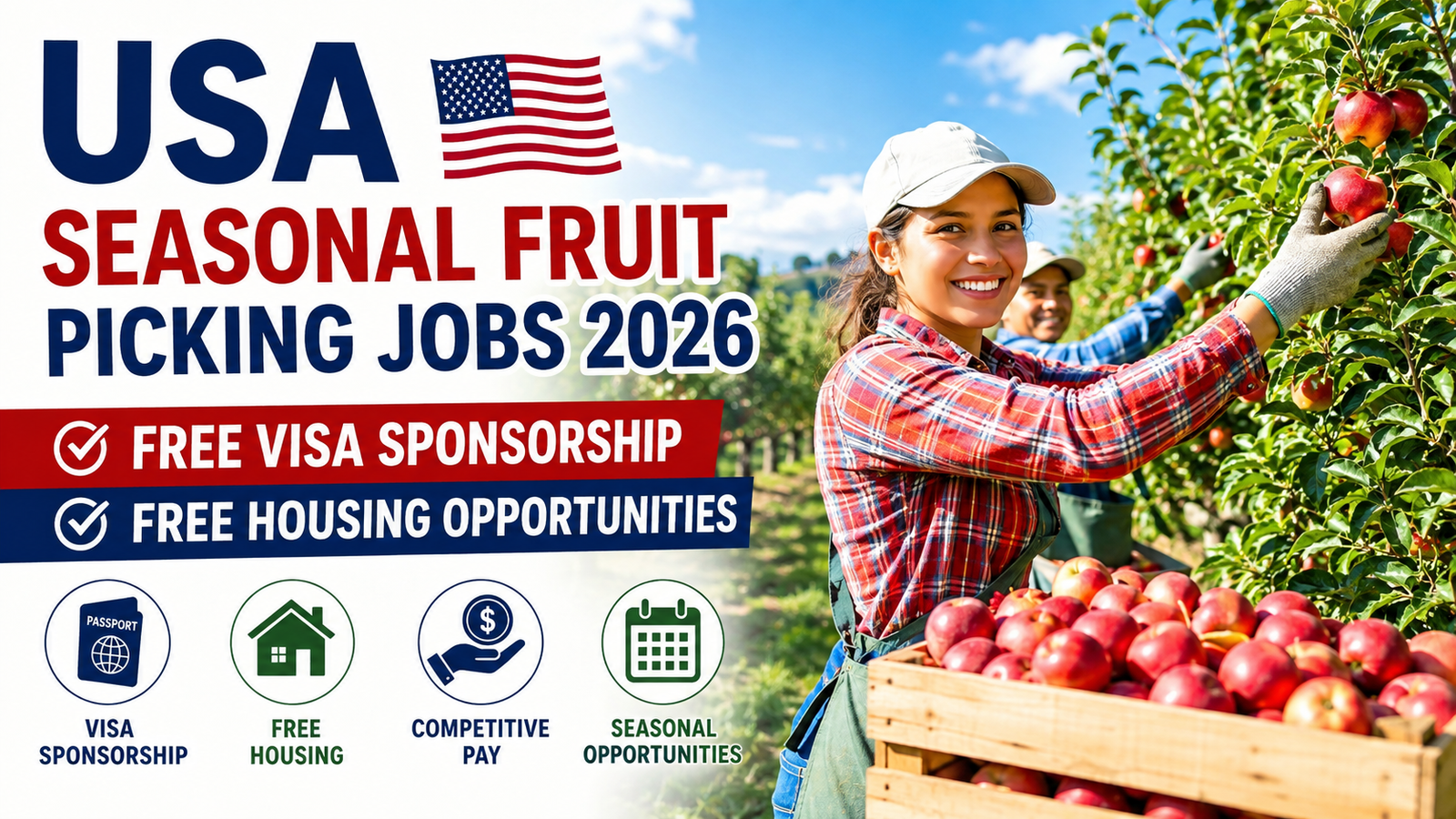
USA Seasonal Fruit Picking Jobs 2026: Visa Sponsorship & Free Housing Opportunities
If you are looking for the USA seasonal fruit picking jobs in 2026, the U.S. agricultural sector can offer temporary opportunities for workers interested in harvesting fruits, vegetables, and a other crops. Many international agricultural workers enter the United States through the H-2A temporary agricultural worker program, although eligibility depends on the employer, the job, the worker’s nationality, and U.S. immigration all rules.
One most important point should be made clear at the beginning: “free visa sponsorship” does not mean that every cost associated with a traveling to the United States will automatically be free. In an H-2A position, the employer generally handles the required labor-certification and petition process, while workers must still follow the applicable visa and consular procedures. H-2A rules also provide very important protections concerning housing, transportation, or wages, meals, and working conditions.
This guide full explains how USA fruit-picking jobs work in 2026, what kinds of the crops workers may harvest, how H-2A sponsorship works, what “free housing” actually means, typical requirements, where to a find legitimate vacancies, how to avoid recruitment all scams, and how to prepare a very strong application.
Overview of USA Seasonal Fruit Picking Jobs
Seasonal fruit picking is one of the most recognizable forms of the temporary agricultural employment in the United States. Depending on the region and a growing season, farms may recruit workers for the activities such as a picking, harvesting, sorting, packing, or pruning, thinning, planting, and the general crop maintenance.
The jobs are usually physically high demanding and may involve working outdoors for the extended periods. Workers can spend much of the day walking, standing, bending, or lifting containers, climbing ladders where the permitted, or working in a hot, cold, humid, or rainy conditions. The exact duties depend on the crop and employer.
For international applicants, and the H-2A program is particularly important because it allows eligible U.S. agricultural employers to urgent hire foreign workers for temporary or seasonal agricultural labor when program many requirements are satisfied. Employers must generally demonstrate that there are not enough qualified and a available U.S. workers for the positions and comply with recruitment and the employment requirements.
That means applicants should not think of these positions as ordinary permanent jobs. Most are tied to a particular farm, crop, location, and contract period.
What Is the H-2A Visa?
The H-2A visa is a U.S. temporary agricultural the worker visa. The U.S. Department of a State describes H-2A as the visa category for applicants performing temporary or the seasonal agricultural work. Only nationals of countries designated under the applicable rules are generally eligible, subject to limited exceptions.
The process normally involves several stages. An employer first needs to meet the Department of Labor’s requirements for temporary agricultural employment and recruitment. The employer then proceeds through the required immigration petition process, after which an eligible worker can complete the applicable visa process.
This is why advertisements using phrases such as “USA fruit picker visa sponsorship 2026” should be read carefully. A genuine employer-sponsored H-2A position should have the identifiable employment terms rather than a simply promising that a visa will be issued.
The employer’s job order or work contract should provide very important information such as the work location, contract dates, crop or some duties, working hours, pay rate, housing arrangements, transportation provisions, and a other employment conditions.
Key Highlights for the 2026
Here are the most important some points applicants should understand the before applying:
- H-2A is the main temporary a visa category for seasonal agricultural workers.
- Fruit picking and the harvesting can qualify when the position and a employer meet H-2A requirements.
- Jobs are temporary rather than permanent immigration opportunities.
- Employers must follow recruitment requirements before obtaining H-2A certification.
- Eligible workers must receive the applicable employment terms in writing.
- Workers who cannot reasonably return home the same day generally must receive safe housing at no cost.
- Required daily transportation between employer-provided housing and the worksite must generally be provided at no cost.
- Employers must comply with applicable wage requirements.
- Workers generally receive a three-fourths guarantee for the hours stated in the contract.
- Employers cannot charge H-2A workers for employer-side recruitment, certification, or similar prohibited costs.
- Legitimate vacancies can be researched through the U.S. Department of Labor’s SeasonalJobs.dol.gov system.
These protections make it especially important to read the actual job order instead of relying solely on a social media advertisement or recruitment agent.
Types of Fruit Picking Jobs in the USA
The exact jobs available change from the one agricultural region to another. The United States has several major fruit-producing areas, and so seasonal opportunities can appear at very different times of the year.
Apple Picking Jobs
Apple harvesting is very strongly associated with states such as Washington, New York, or Michigan, Pennsylvania, Virginia, and other a producing regions. Workers may pick apples by hand, place fruit into containers, and assist with the sorting or packing.
The work can be physically high demanding because workers may repeatedly bend, carry containers, or a work around orchard trees.
Strawberry Picking Jobs
Strawberry farms may recruit workers for the harvesting, field good maintenance, packing, and related activities. Because strawberries are low-growing crops, picking can require the frequent bending or a kneeling.
Blueberry Picking Jobs
Blueberry harvesting can involve hand picking, sorting, packing, and the other farm duties. Seasonal demand varies significantly by state and the growing conditions.
Cherry Picking Jobs
Cherry harvesting is particularly important in some western agricultural regions. Workers may perform hand harvesting and assist with sorting and packing.
Peach and Other Stone-Fruit Jobs
Seasonal workers can also be employed in the peach, nectarine, plum, and related fruit operations. Duties may include harvesting, thinning, pruning, sorting, and a packing.
Grape Harvesting Jobs
Grape-related agricultural jobs can involve the harvesting, pruning, vineyard maintenance, and packing. Not every vineyard position is necessarily available to a international workers, and so applicants should verify the individual job order.
What Fruit Pickers Actually Do
A common misconception is that the fruit picking involves only collecting fruit. In reality, agricultural employers may the assign several duties during the season.
A worker could be asked to:
- Pick mature fruit according to employer standards
- Carry harvested produce
- Sort damaged or unsuitable fruit
- Pack fruit into boxes or containers
- Prepare fields or orchards
- Remove unwanted plants or vegetation
- Thin crops
- Prune plants or trees when included in the job order
- Clean work areas
- Load or unload agricultural products
- Perform other related agricultural tasks
The precise duties should always be confirmed from the employer’s job order or written contract.
H-2A employers must provide workers with information about job duties and employment conditions. The contract should identify the crops to be worked on and/or the jobs to be performed.
Salary and Payment Information
One of the most important questions for a applicants is: How much do fruit pickers earn in the USA?
There is no single nationwide salary that the applies to every fruit-picking job. Pay depends on the state, crop, employer, job order, or wage methodology, and whether compensation is a hourly or based partly on a piece rate.
Under H-2A rules, employers must pay the required wage stated in the job order, and that rate must meet the applicable legal wage requirement. The Department of Labor explains that the applicable rate can involve the highest of specified wage standards, including the applicable adverse effect wage rate, prevailing wage or piece rate, collective bargaining wage, or applicable federal, state, or local minimum wage, depending on the circumstances.
Some agricultural jobs may use piece-rate compensation. For example, workers might be paid according to the quantity harvested. However, when piece-rate compensation is used, applicable wage protections still apply. If piece-rate earnings do not meet the required hourly wage level, the employer must supplement earnings as required.
Applicants should therefore avoid websites that advertise an unusually high salary without showing the actual job order, wage rate, location, contract period, and employer information.
Free Housing and Other Benefits
The phrase “free housing” is especially important in H-2A agricultural employment.
If an H-2A worker cannot reasonably return to their permanent residence within the same day, the employer generally must provide safe housing at no cost. The Department of Labor also requires free daily transportation between the employer-provided housing and the worksite.
This does not necessarily mean that every farm provides a private apartment or hotel room. Housing arrangements can vary. Employers may use temporary labor camps, rental properties, hotels, motels, or other qualifying accommodations, provided the applicable requirements are met.
Housing must meet applicable safety and health requirements. For example, federal standards can address sleeping space, beds, sanitation, water, cooking facilities, and other conditions.
Meals
Employers generally must either provide three meals a day or provide free and convenient cooking and kitchen facilities that allow workers to prepare their own meals. If meals are provided and a charge is permitted, the applicable charge should be disclosed in the employment terms.
Transportation
Transportation rules are another important H-2A protection. Employers must generally provide or pay for required transportation and daily subsistence under the applicable rules, with reimbursement requirements tied to completion of portions of the contract in situations where the employer did not advance the costs.
Therefore, an advertisement saying “free housing and transportation” may be based on real H-2A protections, but applicants should still verify the exact terms in the official job order.
Requirements for the International Applicants
Requirements vary by employer and position, and but seasonal fruit-picking jobs often focus more on physical ability and a availability than on the formal academic qualifications.
Common requirements may a include:
Physical fitness: Workers may very need to stand, bend, walk, or lift, carry, and perform repetitive tasks for long periods.
Ability to work outdoors: Agricultural work can take place under the changing weather conditions.
Reliability: Farms depend heavily on a workers arriving on time and the completing scheduled tasks.
Basic communication: Depending on the employer, workers may very need enough English or another language to a understand instructions and workplace safety all information.
Valid travel documents: Applicants need appropriate documentation for the visa process.
Visa eligibility: Applicants must meet the requirements of the applicable H-2A process and visa rules.
Employer selection: Even if a person meets basic requirements, the employer decides whom to hire from eligible applicants.
Applicants should never assume that previous agricultural experience is automatically required. Some job orders may accept workers without previous experience, while others may specify experience or physical requirements.
How Visa Sponsorship Works
The term visa sponsorship can be confusing.
For an H-2A worker, the employer is responsible for completing the required employer-side immigration and labor-certification procedures. The Department of Labor requires employers to conduct recruitment for available U.S. workers and to meet various program conditions.
The basic process can be summarized as:
Employer identifies temporary agricultural need → recruitment and DOL process → certification/petition process → worker applies for visa when required → worker travels to the United States → worker performs the contracted job.
The worker does not simply apply for an H-2A visa independently and then search for any farm job after arriving.
This distinction is extremely important. A legitimate H-2A opportunity is connected to a specific employer and employment opportunity.
Read More : Canada Hiring Foreign Mechanics in 2026: Jobs with Full Visa Sponsorship Available
Step-by-Step Application Guide
Step 1: Search Official Job Listings
Start by checking the U.S. Department of the Labor’s SeasonalJobs.dol.gov system. The Department specifically advises workers to use the site to verify whether an many application for temporary labor certification was submitted and to a look up employers, locations, and job all duties.
Step 2: Review the Job Order
Do not apply based only on a headline such as “USA fruit picking visa sponsorship.”
Read the actual vacancy carefully. Check:
- Employer name
- Job location
- Crop
- Start date
- End date
- Number of workers
- Wage rate
- Working hours
- Housing
- Transportation
- Meals
- Application instructions
Step 3: Prepare Your Documents
Depending on the employer and visa process, you may need documents such as:
- Passport
- Application forms
- Employment information
- Previous work history
- Photographs where required
- Visa-related documentation
- Employer-provided paperwork
Do not submit false information or altered documents.
Conclusion
USA seasonal fruit picking jobs in the 2026 can provide temporary agricultural employment opportunities for eligible workers, including international applicants who qualify under the H-2A program. Fruit harvesting can involve apples, berries, or cherries, peaches, grapes, and other crops, with the exact opportunities changing according to a location and growing season.
For international workers, and the most important lesson is to verify the opportunity before spending money or submitting sensitive some documents. A genuine H-2A position should be connected to a real agricultural employer and a legitimate job order. The U.S. Department of Labor requires H-2A employers to follow recruitment rules and provide very important information about wages, duties, hours, or housing, transportation, meals, and a other employment conditions.
The phrase “free housing” can be legitimate under H-2A rules when the worker cannot reasonably return home the same day, but applicants should still confirm the exact arrangement in the official job order. Similarly, “visa sponsorship” should not be interpreted as a guarantee of visa approval or as an offer of permanent immigration.
The safest approach is straightforward: find the job through a reliable source, verify the employer, read the official job order, understand the contract, avoid suspicious recruitment fees, and follow the official visa process. Seasonal farm work can be physically demanding, but for eligible applicants it may offer a legitimate way to obtain temporary U.S. agricultural employment while receiving important workplace protections.